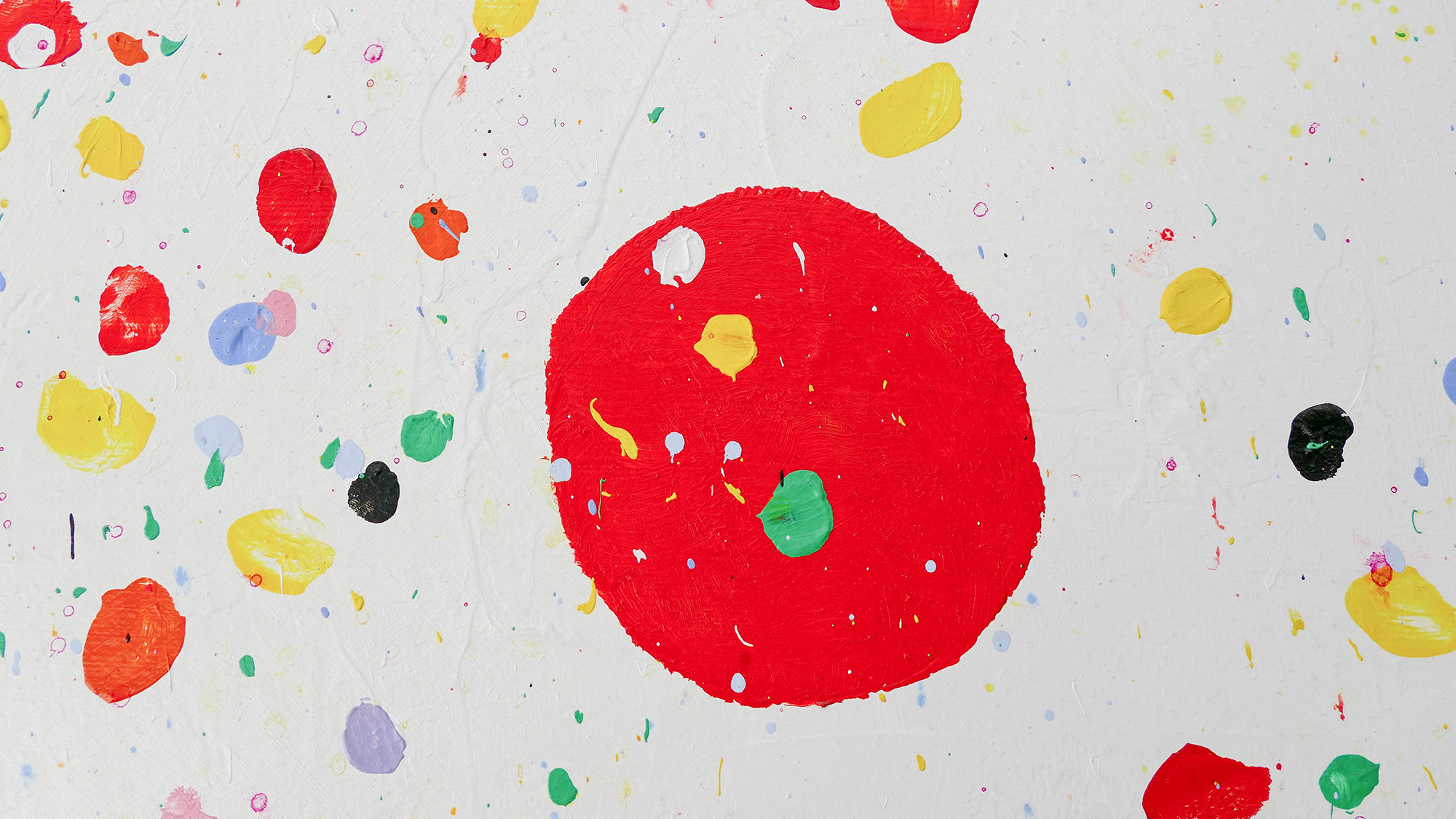
Marie Curie, after many years and many tonnes of uranite, succeeded in isolating two new elements for humankind: polonium and radium. Every gram of uranite contains molecules of these two new elements; they are invisible, but they are there. The same is true of art: there are many works of art, and in a corner of each one there is a new element for humankind.
In this article, we bring together some of the works of art that coexist with science and our daily lives at the Barcelona Biomedical Research Park (PRBB).
Of comets and cells
A wandering comet crossing a galaxy, heading straight for the neighbouring black hole… bound for a dimension unknown! A cell undergoing mitosis, silently surrounded by other elements unrelated to the process of creation. It is Ras 3, and it is the first thing you see every morning at the PRBB reception.
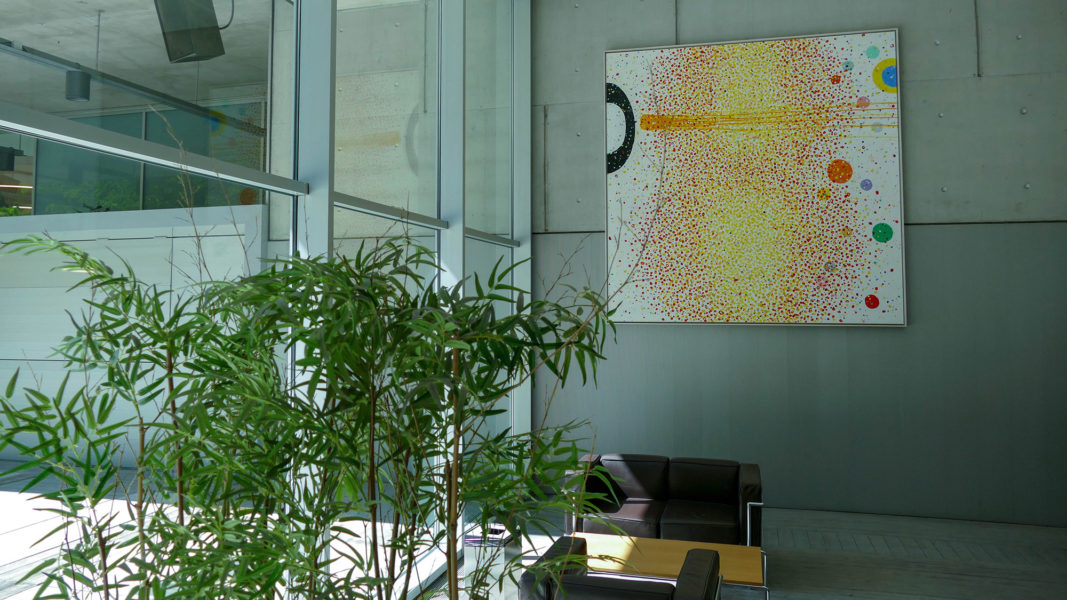
Ferran García Sevilla (Palma de Mallorca, 1949) began his career in the 1980s, with an elemental and instinctive sensibility, bridging the gap between primitive cultures and urban graffiti. García Sevilla’s painting sometimes resembles a sky full of fireworks, at other times a tribal dance; it also provokes, denounces and makes us reflect on time, space and colour. The painter says of himself: “I do not paint the pictures; the pictures paint me”. It is time that shapes humans, and not the other way round.
And the painting is merely the trace, the trail left by the comet. Now that the afternoons blend into the night, when you leave the PRBB, pass through the access control and are about to head home, look back: all that light promises that spring will come one day.
Ethics or aesthetics?
According to the German philosopher Heidegger, the problem of art is not a question of aesthetics but of truth. In conceptual art, the ideas within the work are more important than the object itself, and the work of conceptual art is created in our brains over time. Thus, the viewer becomes the creator.
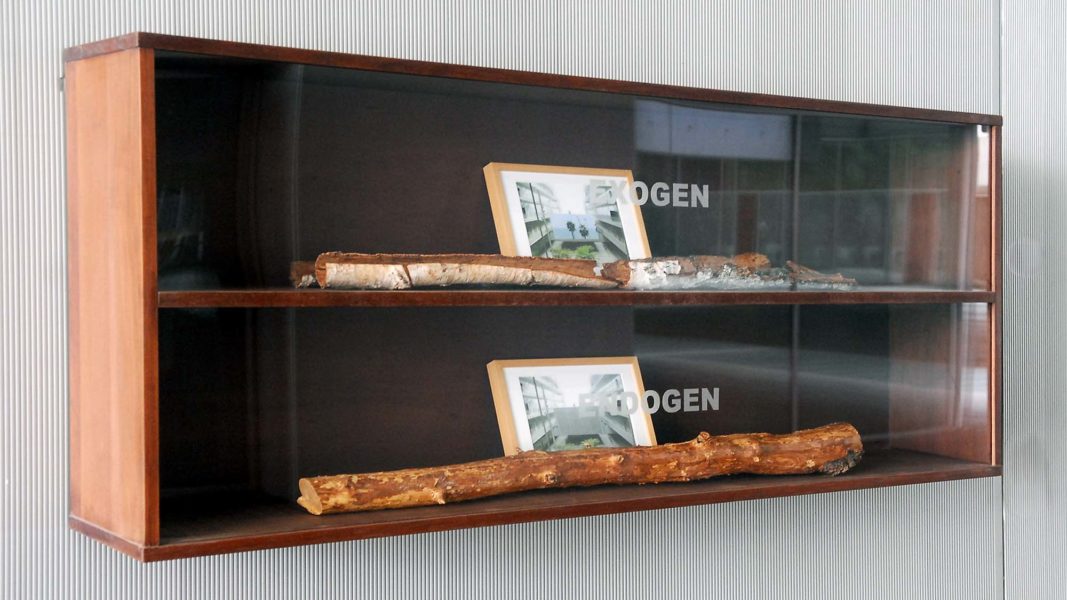
‘Exogenous/Endogenous’, by Francesc Abad (Terrassa, 1944), is, curiously, situated outside the building in the PRBB’s inner courtyard. ‘Exogenous’ (outside) is the bark of a tree bearing an image of palm trees; ‘Endogenous’ (inside) is a trunk stripped of its bark and without any projected image. Bark on its own is inert; it cannot regenerate a tree, and the inside of the trunk will not survive for long without producing new bark. They cannot exist without one another.
Critical thinking encourages us to reflect on the information we receive, and it is this that shapes our own minds. They say that everything we know is reflected in our eyes, and that everything we have experienced is reflected in our skin.
Of Greeks and numbers
Of Greeks and numbers
We shall begin with three words: Kalós, meaning beauty; Eidós, meaning image; and Scopeo, the verb ‘to observe’. These are three Greek words which, when combined, form the term ‘kaleidoscope’ a device which, when operated correctly, produces a beautiful and ever-changing image.
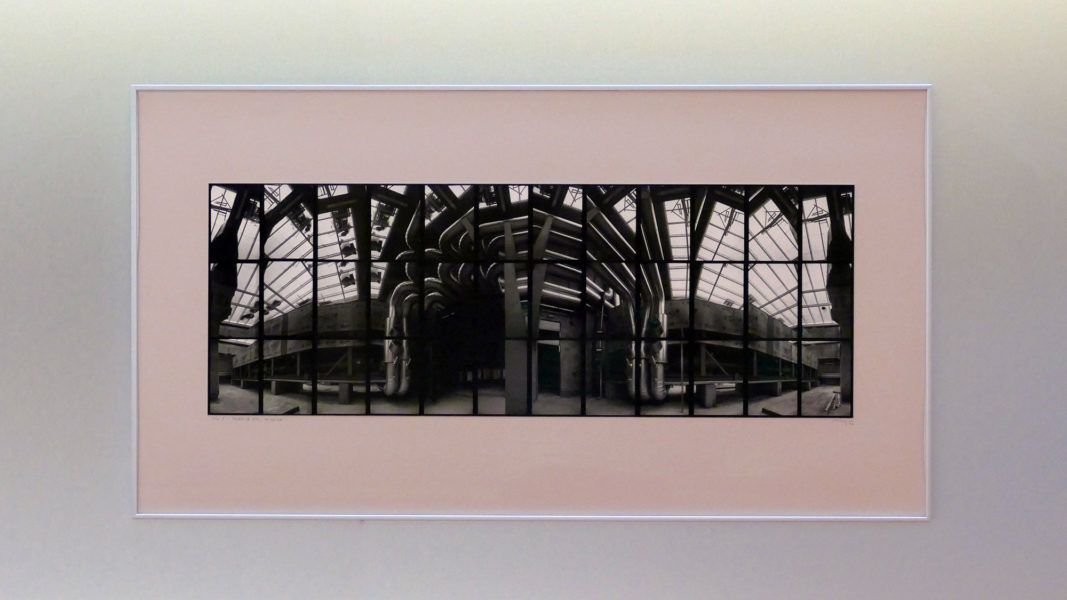
Manuel Serra (Barcelona, 1949) created a kaleidoscope. Using a 36-exposure film, he took one photograph from a right angle, then one at an oblique angle and another at the horizon, a total of three exposures from the same point. He repeated the movement 12 times until he had rotated 360° on his own axis, organised them in logical order and, as a result, obtained an infinite number of images of the PRBB buildings situated within the Consorci PRBB offices.
The word ‘photography’ also comes from Greek and means ‘to draw with light’, and a photograph captures the light and shadows of the reality we see on photographic paper. But when we see them developed, the images are not the same as those we saw at the start. Just as painters decided to stop merely representing nature and instead interpret it, photography has freed itself from the burden of exactly reproducing a building and has drawn several where everything is yet to be done and everything is possible.
Monsters
According to Pythagoras, music is the auditory translation of something as abstract as mathematics, which is the structure of the universe. And what is more abstract and comprehensible than music? In the boardroom of the Consorci PRBB, on the fourth floor of the Park, we find two works by Antoni Tàpies (Barcelona, 1923 – Barcelona, 2012) which attempt to be the visual translation of that which has neither form nor colour into a language that is not always easy to understand: painting.
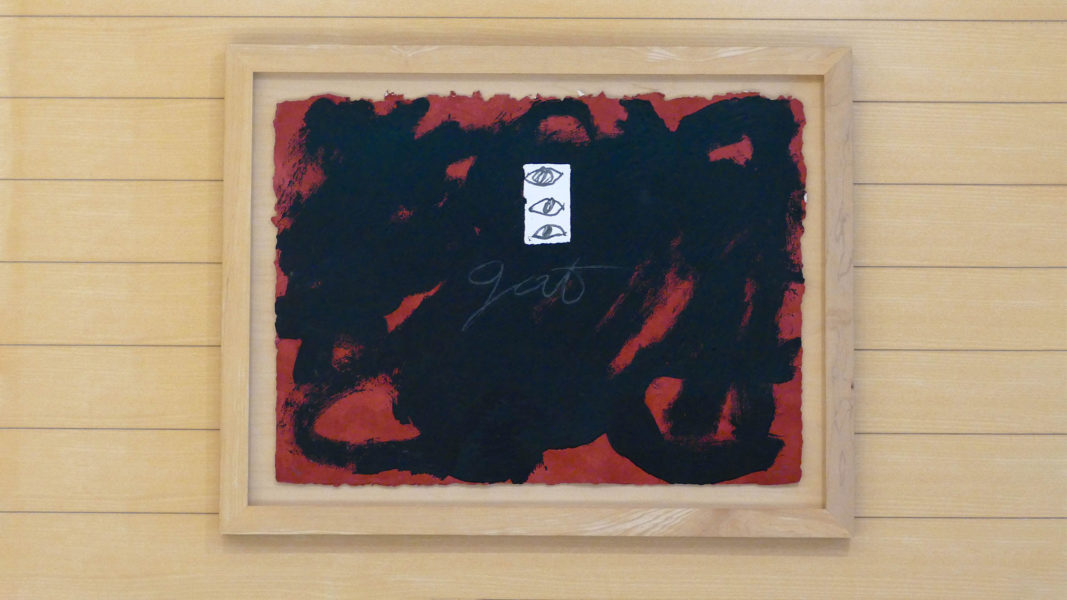
There are people who suffer from anxiety disorders; they say they feel a weight pressing down on their chest, making it hard to breathe, and sometimes even making it difficult to go to the supermarket. If they could rip that sensation from their chest and smash it against the wall, it would surely look like ‘GAT’: three eyes on a black shape against a red background, staring back at us. It resembles the creatures that used to live under the bed and inside the wardrobe when we were little; it is the fear of fear itself, the fear of not knowing what is happening to us and of being unable to control it. Fortunately, Antoni Tàpies has given it shape and colour, and now we know the face of the monster that follows us round the supermarket and prevents us from breathing easily.
Abracadabra
Shaping this invisible world is a complex task. Tàpies strips matter of its true meaning and goes beyond that. He takes a canvas and scratches it, sticks newspaper onto it and paints over it. He seems to want to see if the material has any inner life. But ever since he began painting dreams, painting what exists only in the mind, it seems he has a desire to give form to that which has none. He gives form to the soul and soul to form; he brings the real object into being. It is as if he were throwing a tin of paint to reveal the figure of the invisible man, or staining a cell to view it under a microscope.
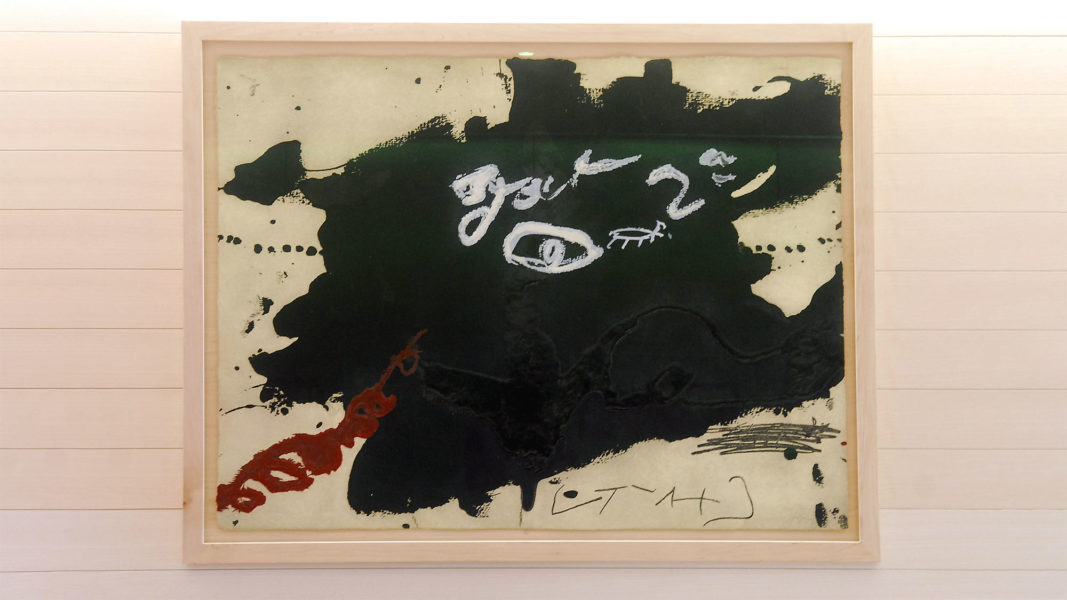
Language (the alphabet), according to Tàpies, is reason’s legitimate means of reproducing mental images. No one will ever paint anything that resembles our own reality. In this second work, entitled Roig i negre 1 (1985), the letters g a t appear. Starting with three letters, the brain has made a very rapid association of ideas, although there is nothing in the image that makes us think… what makes us think? As if by magic, abracadabra, something has appeared before us, and according to our experience, it shouldn’t be there. Say the sounds ‘g’, ‘a’ and ‘t’ in succession and pay attention to the image that has appeared in your mind; it will be the true image, tailor-made from your unique and personal experience. From here on, you are free, discover the new world!
Art walks hand in hand with science
The Barcelona-based artist Antoni Llena (1942) is the creator of the giant face in the square near the PRBB (yes, the one you walk past every day on your way to the underground). It’s called David and Goliath; if you stand underneath it, you’ll be able to tell who’s who.

Llena is also the creator of that painting which everyone looks at but nobody understands, which hangs at the back of the LabCafè and is entitled ‘Writing in a dying language (painting)’. Llena paints the ephemeral, the fleeting, yet it remains hanging on a wall to remind us that time is measured in seconds, that everything passes by…
The texts on the artworks are by Isabel Ràfols and were originally published in Ellipse.