What will we be able to do with biology in a few years’ time? Will it be possible to modify the microorganisms that live in our bodies so that they help us fight disease? To develop a treatment for just one person? To act on specific brain circuits without surgery? And what will happen in laboratories when artificial intelligence and automation take over part of the experimental work?
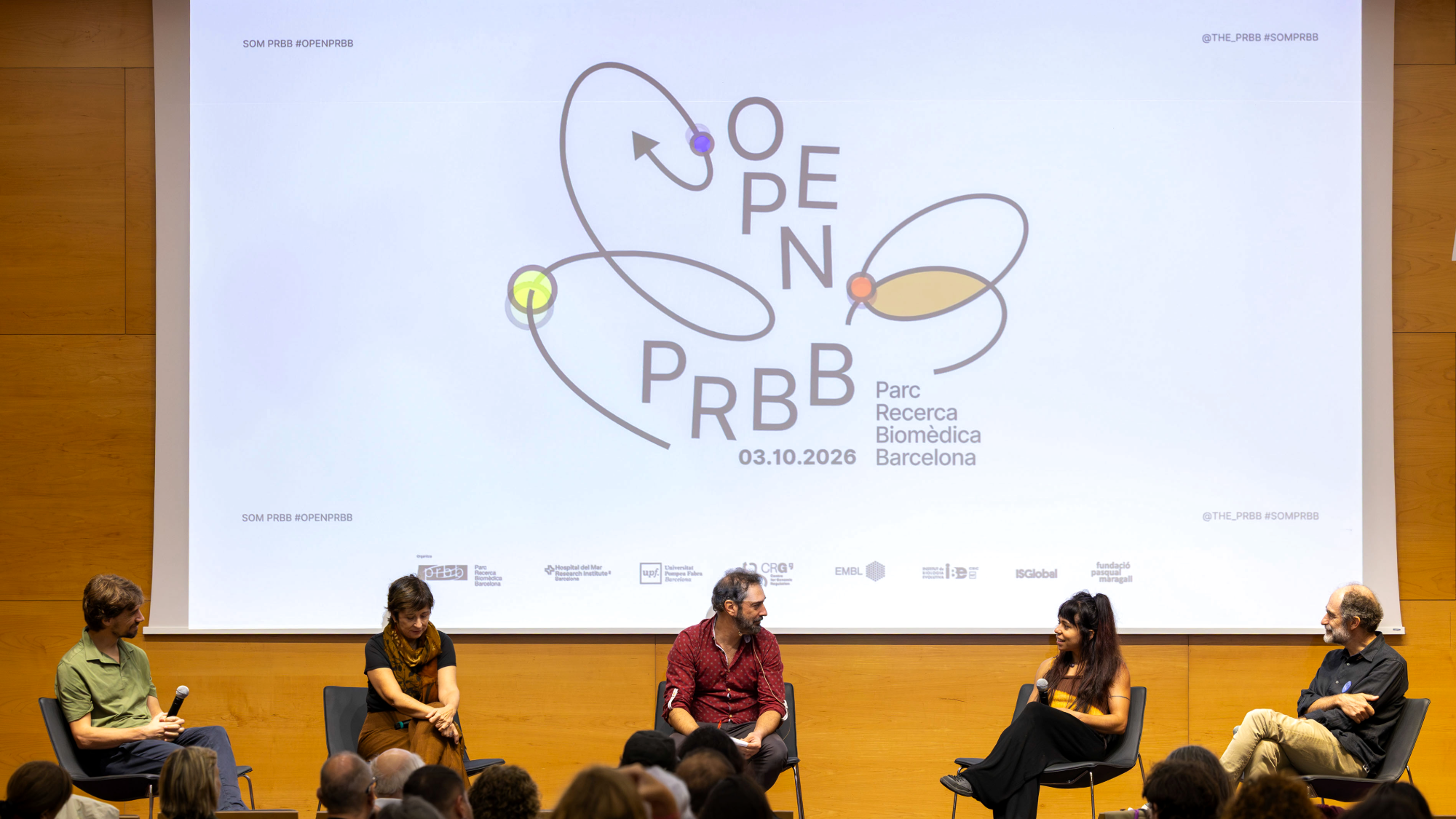
These were some of the questions that emerged on 3 October during the OpenPRBB 2026 scientific vermouth. Moderated by biochemist and science communicator Pere Estupinyà, the conversation brought together Juana Díez and Marc Güell, from the Department of Medicine and Life Sciences at Pompeu Fabra University (MELIS-UPF), and Sara Mederos and Pablo Villoslada, from the Hospital del Mar Research Institute.
The conversation was not so much about guessing what the next major discovery will be, but about looking at some of the technologies that are already beginning to change what we can do with living systems.
Preparing for the virus we do not yet know
“Obviously, it will happen again. What we do not know is which virus it will be”, warned Juana Díez, speaking about future epidemics. The question, therefore, is not only how we will respond to the next outbreak, but whether we can be prepared before it appears.
Díez leads the Molecular Virology Group at MELIS-UPF, which studies RNA viruses and, in particular, how they use the machinery of the cells they infect to multiply. One of the implications of this research is especially relevant for the future, as identifying mechanisms shared by different viruses may make it possible to develop broad-spectrum antivirals or platforms capable of generating new treatments much more quickly.
COVID-19 showed just how quickly a new virus can spread, but this is not the only route by which viruses can emerge. Some viruses that once circulated only in certain regions may find new territories thanks to human mobility or environmental change. During the vermouth, Díez gave the example of dengue, a virus that can be transmitted by the tiger mosquito. This mosquito, first detected in Catalonia in 2004, is now established in the territory and creates the conditions for viruses once associated mainly with tropical regions to potentially be transmitted locally.
In the face of this uncertainty, the virology of the future may not be able to predict exactly which virus will appear, but it may have a first line of defence ready to act against entire families of viruses.
This is precisely one of the lines of research in Díez’s group. In 2026, the laboratory described how different coronaviruses can modify the cellular machinery that regulates transfer RNAs to produce their proteins more efficiently. Interfering with pathways involved in this mechanism reduces the expression of viral proteins and opens the door to searching for drugs that act against a process shared by several coronaviruses.
The group is also working on an RNA-based platform designed to rapidly develop new antiviral molecules. The idea is to combine two strategies. On the one hand, to have broad-spectrum antivirals available as a first barrier, and on the other, technologies that make it possible to design specific treatments in a short time when a new pathogen emerges.
From taking a drug to programming a living organism
With Marc Güell, the conversation also opened up the question of what would happen if, instead of administering a molecule, we could programme a living organism to produce it exactly where we need it.
His Translational Synthetic Biology laboratory at MELIS-UPF works, among other areas, on genetic editing and microbiome engineering. One of its lines of research consists of turning microorganisms that already live with us into potential therapeutic tools.
Güell explained that the skin is a good example. His group works with Cutibacterium acnes, one of the most common bacteria in skin follicles. They have managed to modify it so that it produces molecules with biological activity and have developed new genetic tools to control what it produces, when it does so and how it remains on the skin.
One of the first applications has been acne. The group has managed to genetically modify this bacterium so that it produces a molecule capable of reducing sebum production, one of the factors involved in this condition. In experimental models, the modified bacteria were able to colonise skin follicles and produce the therapeutic molecule there.
“It is a very beautiful moment for biology”
Marc Güell, principal investigator of the Translational Synthetic Biology laboratory at MELIS-UPF
The idea is to turn bacteria that are already adapted to live in a very specific place in our bodies into small programmable therapeutic factories. For example, during the vermouth Güell also explained that bacteria capable of generating heat had been explored, initially in response to a challenge set by a US agency interested in protecting people exposed to very low temperatures. For now, he warned, this is experimental research, but it is also an example of how far biological engineering can go.
“It is a very beautiful moment for biology”, Güell commented during the conversation. Not because these technologies are simple or immediate, but because some ideas pursued for decades are finally beginning to show results.
From treating a disease to intervening in each patient, each gene and each circuit
The neurological medicine of the future could be much more personalised and precise than it is today. Instead of applying the same treatment to thousands of people with the same diagnosis, some therapies are beginning to target very specific genetic alterations and, in some cases, even a single patient.
Pablo Villoslada, a neurologist and director of the Neurosciences Programme at HMRIB, presented several technologies that are already pointing in this direction. One of them is antisense oligonucleotides (ASOs), small molecules designed to act on specific RNAs. In some neurological diseases of genetic origin, identifying the mutation responsible can make it possible to design a therapy targeting that specific mechanism.
In some cases, this opens the door to N-of-1 treatments, designed practically for a single person or for very small groups of patients with extremely rare genetic variants. There are already recent examples of this type of therapy developed specifically for people with genetic forms of amyotrophic lateral sclerosis (ALS). It is still an experimental approach and difficult to scale, but it shows how far personalised medicine can go.
“When a person arrives with a mutation that is potentially treatable, a race against time begins”, he commented. Cells must be obtained from the patient, different molecules tested on them, and an attempt made to reach a therapy before the disease progresses too far.
But precision medicine will not necessarily have to be molecular. Another of the technologies Villoslada highlighted was focused ultrasound, which can direct energy to very specific points in the nervous system. High-intensity focused ultrasound is already used in some contexts to produce controlled lesions, while low-intensity focused ultrasound is being studied as a tool for non-invasive neuromodulation, capable of modifying neuronal activity without destroying tissue.
And there is a third frontier, Villoslada explained: recovering functions that the nervous system has lost. He gave the example of people with ALS who can no longer speak. Brain-computer interfaces can record the brain signals associated with the intention to speak and use artificial intelligence algorithms to interpret these signals and convert them into language. It is still an experimental technology, but it has already been shown that this type of interface can restore a form of oral communication in people with ALS with severely impaired speech.
Understanding how the brain decides to intervene more effectively
The possibility of acting on neuronal circuits immediately raises another question: how do we know which circuit we should modify, and what will happen when we do so?
“We are still far from fully understanding which circuits underlie our behaviour, decision-making, memory or who we are”
Sara Mederos, co-director of the Neural Computation Laboratory at HMRIB.
Her group studies how the brain combines information from the environment with previous experience and internal state to adapt behaviour. The same situation, for example, can lead to different decisions depending on whether we perceive the environment as safe or threatening.
Mederos also stressed that this computation does not depend only on neurons. Glia, long considered mainly as a support system, also participates in modulating neuronal activity, as do systems such as dopamine, serotonin and noradrenaline.
This may be especially important for the biomedicine of the future. Intervening precisely in the brain will not depend only on finding a specific region or circuit, but on understanding how its functioning changes according to the context, experience or state of the person.
During the conversation, Estupinyà asked whether some basic rules that we have not yet discovered might lie behind all this complexity. Mederos was not so sure. We may come to explain some processes in a simple way, but that does not necessarily mean that the system itself is simple.
What if the next major change is the way science is done?
Artificial intelligence may not only transform treatments or data analysis. It may also profoundly change how a research laboratory works.
During the conversation, Juana Díez and Marc Güell imagined laboratories in which an increasingly large part of experimentation is automated or carried out on highly specialised platforms. Researchers could then devote more time to asking questions, designing experiments and interpreting the results.
Güell particularly highlighted the potential of connecting AI with experimental hardware. Both Díez and Güell imagine systems capable of running protocols in an automated and reproducible way, while artificial intelligence helps decide what to test or interpret the results.
Díez took this to a very concrete example. A researcher could define the experiment she needs — working with certain cells, infecting them with a virus or analysing their proteins — and commission its execution from a CRO (contract research organisation) or a specialised infrastructure. Afterwards, AI could help compare and interpret the thousands of data points generated. In a sense, this means taking much further a model that already exists with services such as DNA sequencing. Today, many laboratories send samples to sequencing platforms instead of carrying out the whole process internally, as they did in the past.
Sara Mederos, however, introduced an important nuance. Automating experiments can make research more efficient and reproducible, but doing experiments, making mistakes and understanding why something works or does not also form part of scientific training. This accumulated knowledge is, precisely, one of the foundations of creativity.
And Pablo Villoslada summed it up by saying that “artificial intelligence is like having a Ferrari”: it can be an extraordinarily powerful tool. But first you need to know how to drive it.