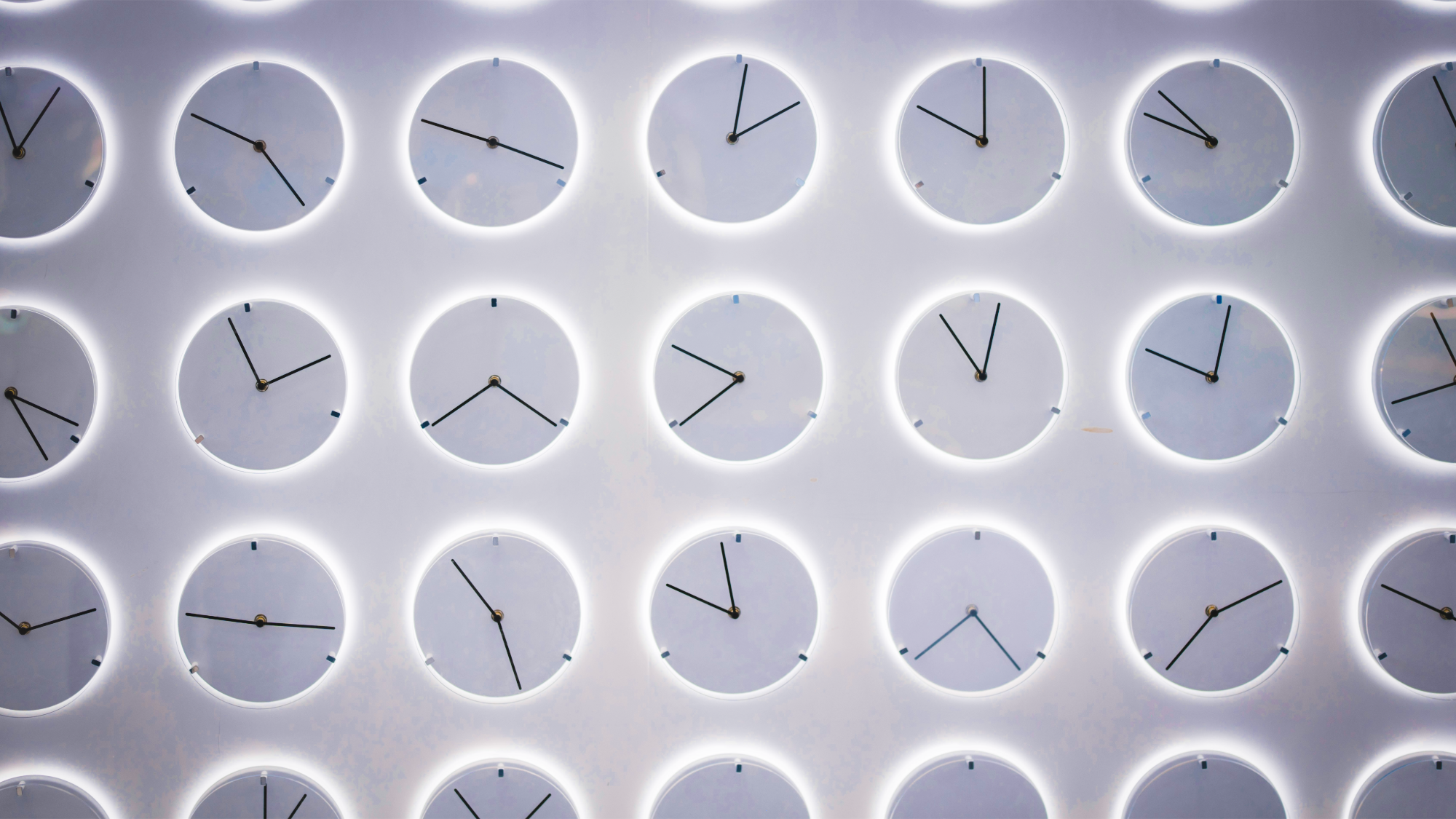
We often think of our body as a machine that works constantly. But the body that has breakfast at eight in the morning is not exactly the same as the one that has dinner at nine at night. Throughout the day, our body temperature, blood pressure, hormone production and immune activity change and even the expression of some of our genes varies.
These changes do not happen at random. They respond, in part, to circadian rhythms: biological cycles of approximately 24 hours that allow us to anticipate the alternation between day and night. Understanding how these cycles work, how they are coordinated and what happens when they are disrupted is a question that can be studied at very different scales. At the Barcelona Biomedical Research Park (PRBB), for example, some teams observe the meal timing of thousands of people, others analyse gene activity in dozens of human tissues, and laboratories study the internal clocks of the skin, muscle or liver. Their approaches are different, but they share the same idea: in biology, when something happens can also matter.
One central clock and many peripheral clocks
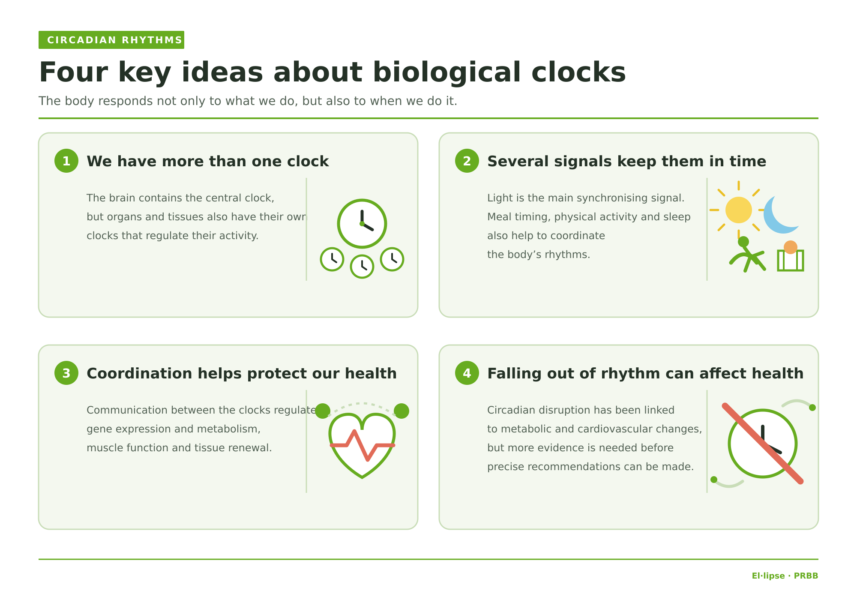
The main circadian clock in mammals is located in the suprachiasmatic nucleus, a small region of the hypothalamus in the brain that receives information about light through the eyes. However, almost every cell has its own molecular mechanism capable of generating oscillations of around 24 hours. The liver, muscles, skin and immune system also have their own “clocks”.
Light is the main signal that synchronises the clock in the hypothalamus. But when we talk about peripheral tissues, other signals also come into play, such as meal timing, fasting, physical activity or temperature. Modern lifestyles, with exposure to light at night, little rest and meals at irregular times, can create a mismatch between external real time, our habits and the internal rhythms of our body.
Genes do not work in the same way at all times of day
One way of seeing how far this regulation extends is to observe gene activity throughout the day. This is precisely what a study led by the research groups of Manuel Irimia, from the Centre for Genomic Regulation (CRG) and the Department of Medicine and Life Sciences at Pompeu Fabra University (MELIS-UPF), and Roderic Guigó, from the Centre for Genomic Regulation (CRG), did. The study analysed gene expression in 46 human tissues from 932 donors from the Genotype-Tissue Expression (GTEx) project.
The research, published in PLOS Biology in 2023, showed that variation between day and night is not the same throughout the body. In the heart ventricles and lungs, around one-fifth of expressed genes varied depending on the time of day; in other tissues, this oscillation was much lower. The team also identified hundreds of genes with day or night patterns shared across tissues and seasonal variations, especially in the brain and in genes related to the immune response.
“These findings could help adjust the timing of drug administration to the circadian rhythms of gene expression. They could also have implications for clinical trials, as the effect of the same dose may vary depending on the season of the year.”
Dr Roderic Guigó, principal investigator at the Centre for Genomic Regulation (CRG)
When the brain, muscle and liver need to coordinate
Knowing that tissues have their own clocks raises the question of how far they can function autonomously and how they communicate with each other. A study published in Cell Reports analysed cooperation between the circadian clocks of muscle and liver.
The research, led by Pura Muñoz-Cánoves, who was then a researcher at Department of Medicine and Life Sciences at Pompeu Fabra University (MELIS-UPF) and is now a Principal Investigator at Altos Labs in San Diego, showed that both tissues could maintain their own rhythms without the central clock, but with less intensity. It also observed that, to properly regulate glucose metabolism, a minimum level of coordination between organs and the support of feeding and fasting cycles were also needed.
Another study, also led by Purificación Muñoz and Salvador Aznar Benitah, from IRB Barcelona, studied communication between the circadian clocks of the brain and muscle. The work, published in Science in 2024, showed in mice that this coordination helps maintain muscle function and prevent premature ageing. In aged animals, restricting feeding to the active phase partially compensated for the absence of the central clock and mitigated the loss of muscle mass and strength.
These experiments cannot be directly converted into recommendations for people, but they show that meal timing acts as a signal that helps coordinate metabolism between organs.
The skin also knows what time it is
A study published in Cell Stem Cell in 2024, led by Thomas Mortimer, from VHIR, and Patrick-Simon Welz, from the Hospital del Mar Research Institute, showed that the epidermal clock does not simply obey the brain’s clock, but interprets signals and adapts them to the needs of the skin.
This coordination helps prevent DNA replication from coinciding with moments of maximum exposure to ultraviolet radiation, when the risk of accumulating mutations would increase.
It is not only what we eat that matters, but also when we eat
If meals help synchronise peripheral clocks, can the time at which we eat influence health? This is the central question of chrononutrition, a field that combines nutrition, circadian rhythms and epidemiology.
At the Barcelona Institute for Global Health (ISGlobal), Camille Lassale’s team studies how the timing of the first and last meal, the duration of overnight fasting and the regularity of eating schedules are related to health in large population cohorts. In 2023, a NutriNet-Santé study associated having breakfast after nine with a higher risk of type 2 diabetes than having it before eight. Another study from the same cohort, with more than 100.000 participants and published in Nature Communications, linked later meals to higher cardiovascular risk. A longer overnight fast was associated with lower cerebrovascular risk when both the first and last meals were also earlier.
In 2024, a study of the Catalan GCAT cohort of adults aged 40 to 65 years old, published in the International Journal of Behavioral Nutrition and Physical Activity, described different chrononutritional patterns in men and women. A later first meal and a shorter overnight fast were associated with a higher body mass index. By contrast, skipping breakfast to extend fasting was not linked to weight loss.
“It is still too early to draw definitive conclusions, and we will need to wait for stronger evidence before making recommendations”
Luciana Pons-Muzzo, first author of the study and researcher at ISGlobal
All these studies are observational, meaning that they can detect associations but do not prove that changing meal timing directly reduces risk. Work, sleep, physical activity, diet quality and socioeconomic status also influence schedules and are difficult to fully separate when carrying out this type of study.
From habits to molecular mechanisms
One of the current challenges is to understand which biological mechanisms could explain the associations observed in cohorts. An ISGlobal study published in Molecular Nutrition & Food Research, coordinated by Camille Lassale, has begun to explore this question during pregnancy. The study analysed the chrononutritional habits of 389 pregnant women from the Barcelona Life Study (BiSC) cohort, as well as placental samples. Dinner time was the only factor associated with changes in placental DNA methylation, an epigenetic mechanism that regulates gene activity without modifying its sequence.
The signals affected genes related to cholesterol metabolism, blood vessel formation and the response to DNA damage. The study cannot determine whether these changes have consequences for the mother or the fetus, nor establish an optimal time for dinner. It does, however, offer a possible connection between an everyday habit and the molecular regulation of the placenta.
This connection is also central to the CUPID project, led by ISGlobaland active until February 2027. The project studies the circadian behaviours of more than 8.000 people from the GCAT cohort and analyses, in a subsample, whether DNA methylation may intervene between circadian misalignment and cardiometabolic risk.
When losing rhythm may affect other systems
The consequences of circadian disruption could go beyond metabolism. One of the situations that most clearly puts internal clocks to the test is night work, which forces people to remain active when the body expects to rest and can also shift meal times.
The SHE-WORK project, coordinated by ISGlobal and active until the end of 2028, studies the sexual and mental health of 307 day and night female shift workers. It analyses gut microbiota, eating schedules, hormonal biomarkers and indicators of menstrual and reproductive health. As the project is still ongoing, no conclusions can yet be advanced.
The Hospital del Mar Research Institute is also investigating a possible connection between circadian disruption, the microbiota and brain health. A project led by Patrick-Simon Welz’s group at the Hospital del Mar Research Institute studies whether disruption of circadian communication between the body and the microbiota may affect brain physiology, behaviour and cognition. The research combines experimental models and multi-omics approaches, but its results have not yet been published.
Towards medicine that also takes time into account
PRBB research connects different scales. The CRG studies gene expression; MELIS-UPF and the Hospital del Mar Research Institute study coordination between the brain and tissues; and ISGlobal studies the relationship between daily schedules and the health of thousands of people. Population studies detect patterns, while experimental models help explore their mechanisms.
In the future, this temporal dimension could help refine meal timing, adapt treatments or design interventions for people who work at night. Before that, more experimental and population-based evidence will need to be combined. For now, the research reinforces the idea that the body responds not only to what we do, but also to when we do it.
Find out more
- Irimia Lab, led by Manuel Irimia (CRG).
- Guigó Lab – Computational Biology of RNA Processing, led by Roderic Guigó (CRG).
- Intercellular Communication in Cancer and Ageing, led by Patrick-Simon Welz (HMRIB).
- NutriEpi, led by Camille Lassale (ISGlobal).
Wucher V. et al. “Day-night and seasonal variation of human gene expression across tissues”. PLOS Biology (2023). https://doi.org/10.1371/journal.pbio.3001986
Smith J.G. et al. “Liver and muscle circadian clocks cooperate to support glucose tolerance in mice”. Cell Reports (2023). https://doi.org/10.1016/j.celrep.2023.112588
Kumar A. et al. “Brain-muscle communication prevents muscle aging by maintaining daily physiology”. Science (2024). https://doi.org/10.1126/science.adj8533
Mortimer T. et al. “The epidermal circadian clock integrates and subverts brain signals to guarantee skin homeostasis”. Cell Stem Cell (2024). https://doi.org/10.1016/j.stem.2024.04.013
Palomar-Cros A. et al. “Associations of meal timing, number of eating occasions and night-time fasting duration with incidence of type 2 diabetes in the NutriNet-Santé cohort”. International Journal of Epidemiology (2023). https://doi.org/10.1093/ije/dyad081
Palomar-Cros A. et al. “Dietary circadian rhythms and cardiovascular disease risk in the prospective NutriNet-Santé cohort”. Nature Communications (2023). https://doi.org/10.1038/s41467-023-43444-3
Pons-Muzzo L. et al. “Sex-specific chrono-nutritional patterns and association with body weight in a general population in Spain”. International Journal of Behavioral Nutrition and Physical Activity (2024). https://doi.org/10.1186/s12966-024-01639-x
Llauradó-Pont J. et al. “Maternal Chrono-Nutrition and Placental DNA Methylation: The BiSC Study”. Molecular Nutrition & Food Research (2026). https://doi.org/10.1002/mnfr.70465