Who decides what is researched? Which populations take part in studies, and which are left out? How are resources, authorship and recognition distributed? These are some of the questions raised by the European project INCLUDE (Fostering INCLUsive biomeDicine gEps in research and higher education institutions). The Barcelona Institute for Global Health (ISGlobal), one of the centres hosted at the PRBB, is one of the 11 European organisations taking part in the project.
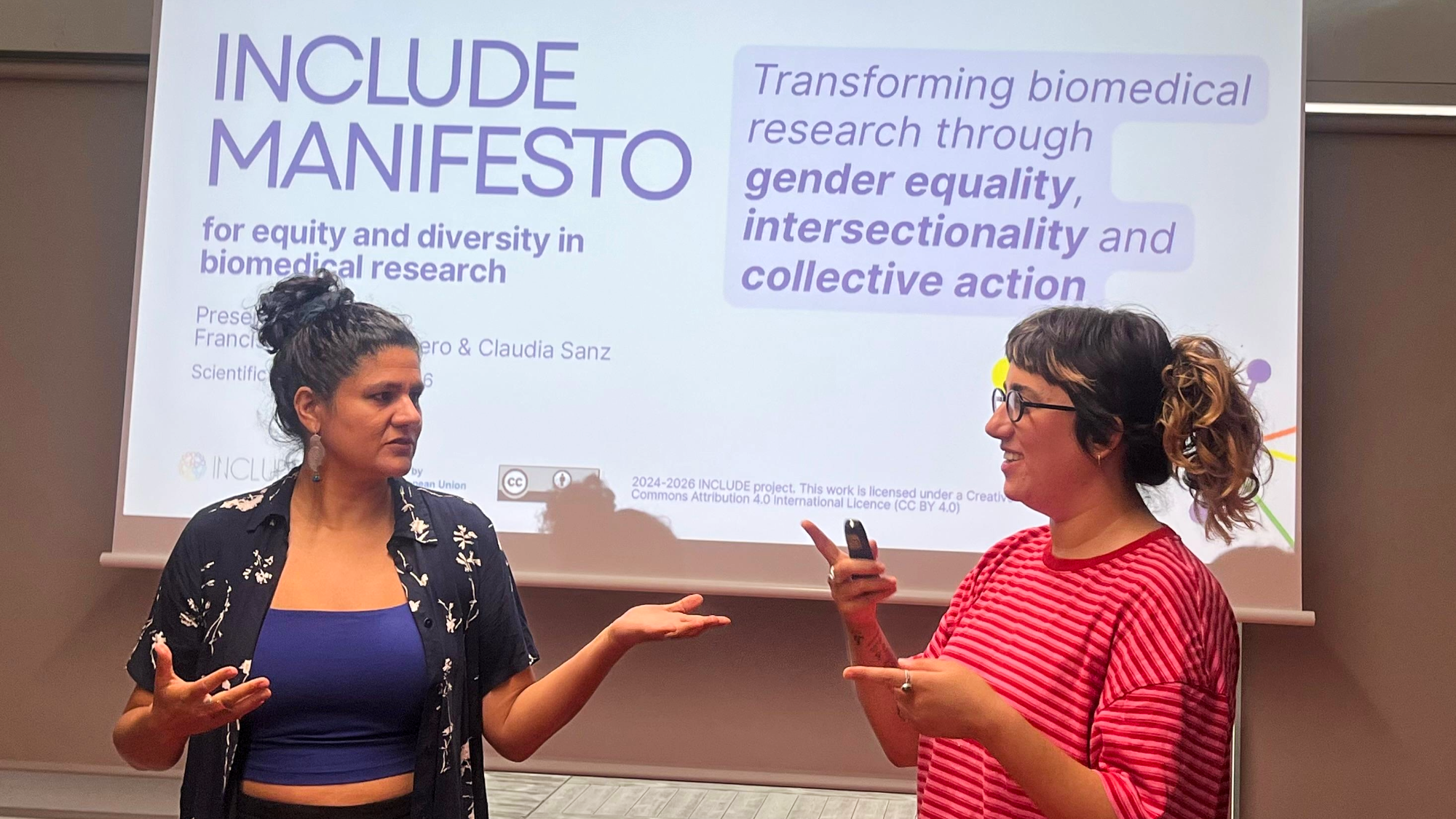
As part of the project, the INCLUDE Manifesto for Equity and Diversity in Biomedical Research has been created. The manifesto calls on both institutions and the research community to address the structural inequalities that shape scientific knowledge, research environments and health outcomes. The manifesto can be supported both personally and institutionally.
On 13 November 2026, the PRBB Auditorium will host the final conference of the INCLUDE project. The event will present the manifesto and other project results, and will open a space for discussion on how to move towards more equitable, diverse and inclusive biomedical research.
We speak to Francisca Casas-Cordero, a sociologist specialising in participatory methodologies and a member of ISGlobal’s Science Culture Unit and its Decoloniality Group, and Claudia Sanz, an environmental scientist, PhD in Environmental Toxicology and outreach officer in the same unit.
What is the INCLUDE Manifesto and what does it propose?
The INCLUDE Manifesto is a tool that brings together the vision and main lessons we have been building throughout the INCLUDE project on equality, diversity and inclusion in biomedical research.
Its starting point is that science is not neutral, nor is it produced outside power relations. This may seem obvious, but in practice it is easy to forget. Research priorities, the distribution of resources, who makes decisions and which forms of knowledge are recognised as relevant are all shaped by inequalities and power relations.
From an intersectional perspective, the manifesto proposes looking at these inequalities in a more complex way. We need to understand how factors such as gender, racialisation, social class, disability, origin and geographical position interact.
Moving towards more equitable science is not only about improving the representation of different groups. It also means reviewing the practices, structures and cultures of scientific institutions.
Why was it important to promote a manifesto like this precisely now?
We are in a contradictory moment. In recent years, many scientific institutions have made progress on equality, gender and diversity policies. At the same time, however, we are seeing these agendas being strongly questioned and, in some contexts, even rolled back.
In addition, many inequalities remain deeply embedded in the way science works. We see this in who has access to decision-making spaces, how resources and recognition are distributed, which populations are represented in research, and the unequal relations that still exist between institutions in the Global North and Global South.
New challenges are also emerging, such as the reproduction of bias through artificial intelligence and data systems. If data are incomplete or biased, these tools can reproduce and amplify existing inequalities.
In this context, we felt it was important to go beyond general statements about diversity and put a more structural discussion about power, inequality and knowledge production on the table.
Which aspects of the manifesto do you consider especially relevant for the PRBB scientific community?
Practically all of them, precisely because the PRBB brings together a very diverse and international scientific community, as well as institutions with different cultures, disciplines and ways of producing knowledge.
But we would particularly highlight the invitation to connect equity and diversity with the quality of science itself. Sometimes these issues are understood as something parallel to scientific activity, mainly related to human resources or institutional policies. The manifesto stresses that they also directly affect what we research and how we do it.
For example, we need to ask ourselves who defines the research agenda, who takes part in a study, which populations are left out, how we interpret data, who we collaborate with, and how we distribute authorship, resources and recognition.
In a space such as the PRBB, where so many disciplines, institutions and people from different contexts coexist, there is a particularly interesting opportunity to open up these conversations. We can think collectively about what it means to produce science that is not only excellent, but also fairer.
How can we prevent support for the manifesto from remaining a symbolic gesture?
This is probably the main challenge. Signing a manifesto does not transform an institution. Institutions often adopt the language of equality and diversity much faster than they change their practices.
The manifesto can help name the problems, create a shared language and open up conversations that are often uncomfortable. But it does not replace policies or structural change.
To have a real impact, each institution should ask itself what these principles mean in its own context and translate them into concrete decisions. This may involve reviewing procedures, allocating resources, establishing responsibilities, generating data that help identify inequalities and creating mechanisms to assess progress.
Finally, it is important to keep the critical dimension open. Intersectionality should not simply become a new institutional label. What makes this concept powerful is precisely that it forces us to ask who has power, who is left out and which structures produce these inequalities.
The manifesto can help open this path, but change depends on what we do with it afterwards.