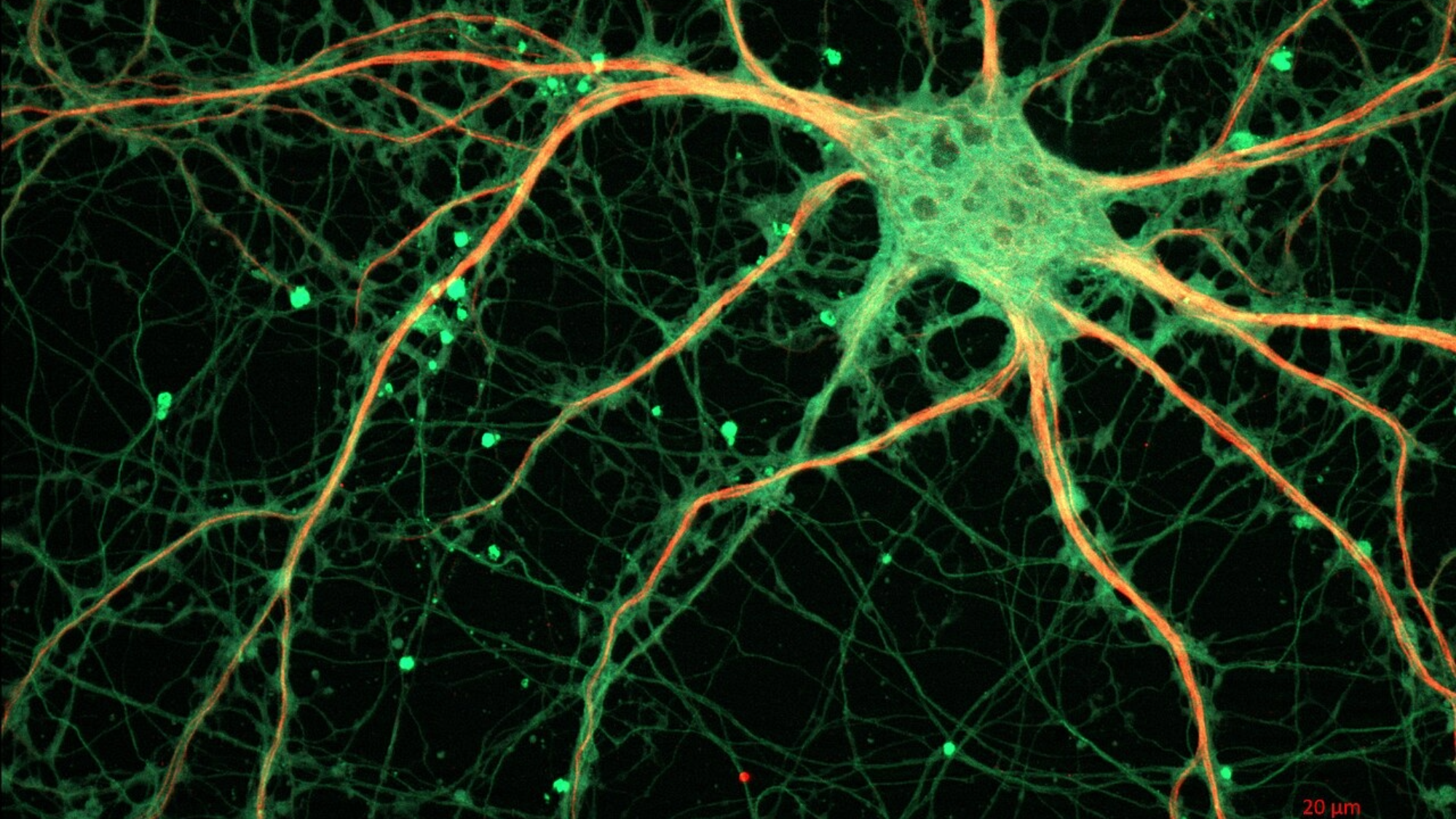
To understand what changes in the brain in fragile X syndrome, analysing whole brain tissue is not always enough. Looking more closely at the connections between neurons can reveal signals that might otherwise be diluted.
This is what a team from the Department of Medicine and Life Sciences at Pompeu Fabra University (MELIS-UPF), one of the centres at the Barcelona Biomedical Research Park (PRBB), has done in collaboration with specialists in RNA bioinformatics. The study, CB1 receptor inhibition restores synaptoneurosomal alternative splicing landscape in fragile X syndrome mice, published in iScience, analyses synaptoneurosomes, preparations of brain tissue enriched in components of neuronal connections.
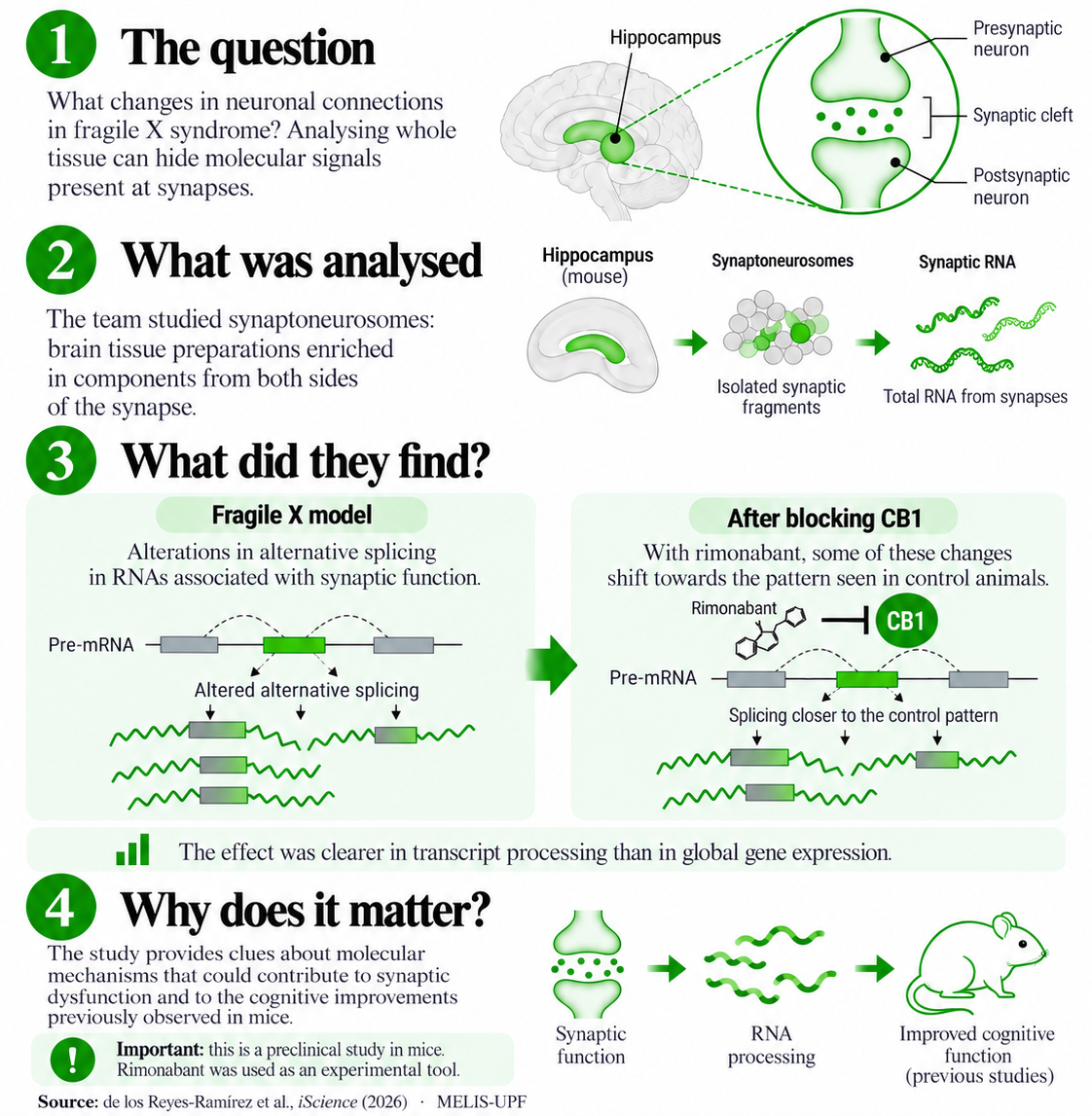
In male mice used as a model of fragile X syndrome, the researchers detected alterations in alternative splicing, the process by which a single gene can produce different versions of RNA. These changes were found in the synapse-associated transcriptome.
“By focusing on synaptoneurosomes, we were able to observe changes in RNA processing associated with neuronal connections that can be diluted when analysing the whole hippocampus. This allowed us to identify alterations in splicing that were less evident at other levels of analysis.”
Lucía de los Reyes-Ramírez, first author of the study, holds a PhD in Biomedicine from UPF and is currently a researcher in the Neurobiology Division at the MRC Laboratory of Molecular Biology.
De los Reyes-Ramírez developed this line of research at the Neuropharmacology Laboratory-NeuroPhar at MELIS-UPF, where she completed her PhD on synaptic transcriptomic changes in fragile X syndrome. She currently works at the MRC Laboratory of Molecular Biology in Cambridge.
When the animals were treated with rimonabant, a compound that blocks the cannabinoid receptor CB1, some of these changes shifted towards the pattern observed in control animals. The treatment had a limited effect on overall gene expression, but its impact was much clearer when the researchers examined transcript processing in detail.
This is one of the study’s main contributions: it suggests that CB1 inhibition could also affect molecular mechanisms involved in RNA processing at synapses.
“What is interesting is that blocking CB1 did not produce major changes in overall gene expression, but it did modify the splicing of numerous RNAs towards a pattern more similar to that of control animals. We now want to understand whether these changes also result in different proteins and what role they may play in synaptic function.”
Andrés Ozaita, Professor of Pharmacology at MELIS-UPF and principal investigator of the Neuropharmacology Laboratory-NeuroPhar.
Ozaita’s research focuses on the molecular mechanisms involved in memory and neuronal plasticity, with particular attention to the endocannabinoid system and neurodevelopmental disorders, including fragile X syndrome.
A receptor also being studied in other disorders
The CB1 receptor is part of the endocannabinoid system and is involved in processes related to memory, learning and synaptic plasticity. Modulating this receptor is also being investigated in other neurodevelopmental disorders.
In this study, however, rimonabant is used as an experimental tool. The findings are preclinical and come from mice, so they do not establish whether this strategy could be used to treat fragile X syndrome in humans.
The next step will be to understand whether these changes in RNA processing also lead to changes in proteins and to what extent they may contribute to improving synaptic function.
De los Reyes-Ramírez, L., et al. (2026). CB1 receptor inhibition restores synaptoneurosomal alternative splicing landscape in fragile X syndrome mice. iScience, 29(11), 117793.