Artificial intelligence is no longer only a topic for the future. It is becoming increasingly present in biomedical research: it helps analyse large volumes of data, detect patterns, build models and open up new questions. But its use also raises important issues for the scientific community: how well do we understand these models? How should we deal with the uncertainty they generate? And what good practices do we need when these tools enter the laboratory?
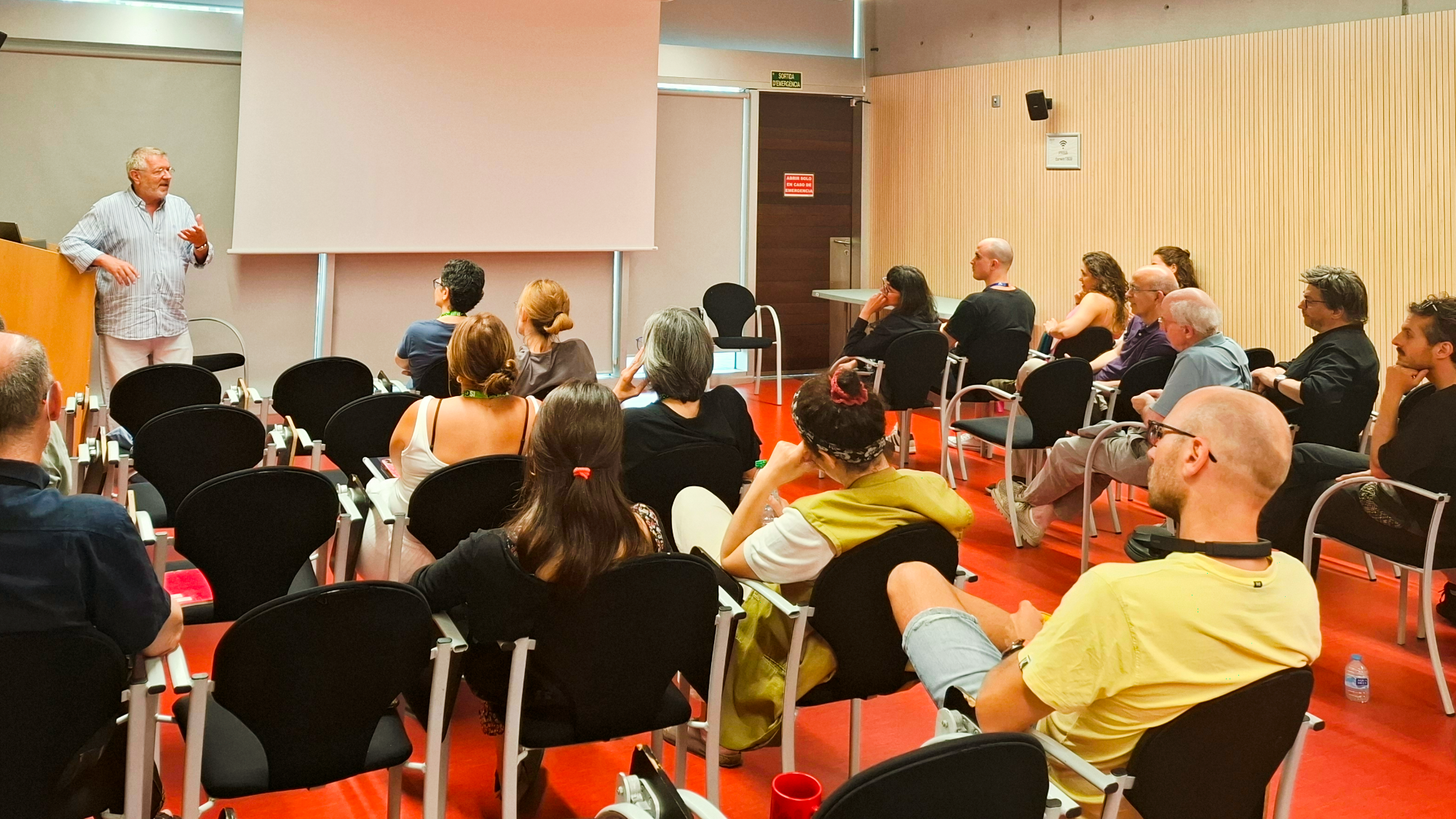
This was the starting point of the cineforum organised on June 2 by the Good Scientific Practice group of the Barcelona Biomedical Research Park (PRBB), which brought together around 30 members of the Park’s community in the Ramon y Cajal room.
The session began with the screening of “Artificial Intelligence – From Mind to Machine”, a documentary produced by The Brain Prize. The film traces some of the historical connections between the study of the brain, computational neuroscience and current artificial intelligence. But rather than offering a closed answer, it raised a broader question about the extent to which the brain is a useful model for understanding AI, and to what extent this comparison is a useful yet limited metaphor.
The activity was introduced by Joana Porcel-Carbonell, Data Protection Officer at ISGlobal and a member of the PRBB Good Scientific Practice group. After the screening, Francesc d’Assís Calafell Majó, associate professor at UPF and principal investigator of the Genomics of Individuality Lab at the Institute of Evolutionary Biology (IBE: CSIC-UPF) and also a member of the PRBB Good Scientific Practice group, moderated a discussion with Gustavo Deco, ICREA Research Professor and full professor at UPF, where he leads the Computational Neuroscience group.
The conversation went beyond the documentary and brought the debate closer to some of the issues currently shaping research: the interpretability of models, the role of uncertainty, possible applications in biomedicine and clinical practice, and the need to use AI with judgement, transparency and responsibility.
The discussion also highlighted that AI is not just a technical tool. It can influence how hypotheses are formulated, how data are analysed and how scientific decisions are made. For this reason, spaces such as this are especially relevant in an environment like the PRBB, where different disciplines, methodologies and centres coexist, many of them with strong biomedical and computational activity.
With this session, the PRBB Good Scientific Practice group continues to promote open conversations about how science is done today.