
The Barcelona Biomedical Research Park (PRBB) and the Faculty of Medicine and Life Sciences at Pompeu Fabra University (UPF) have held a new edition of the Premi PRBB, which recognises the best research projects by high school and vocational training students in the life sciences and biomedicine.
In this 21st edition, 275 projects were submitted by 300 students from across the region. Since the award was launched 21 years ago, 3.528 projects by 3.763 students have been submitted, a number that reaffirms the success of an award which, year after year, continues to be very well received by students.
Among the topics addressed this year, cancer was the most studied, featuring in 10% of the projects. At the same time, the experience of conducting research has also left its mark on the participants, who describe science above all as a fascinating discipline, but also a rigorous and transformative one.
Awards ceremony
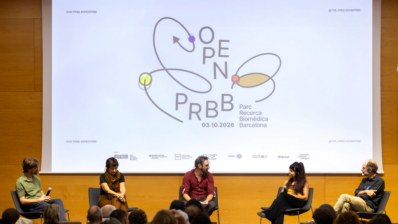
On 17 April, the authors of the five selected projects gathered at the PRBB to present their work and determine the final ranking. In the first part of the event, they presented their research in the form of scientific posters to the juty, comprising Marta Barniol Xicota from MELIS-UPF, Neus Martínez from HMRIB and Román Sapino from IBE, who took the opportunity to exchange views and ask questions about the work carried out.
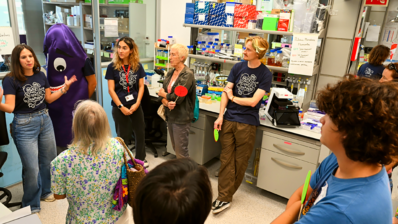
Once the presentations were over, the jury withdrew to deliberate whilst the finalists and their companions took a tour to learn about the PRBB building and its research. On their return, the director of the PRBB, Jordi Camí, the dean of the UPF’s Faculty of Medicine and Life Sciences, Joan Ramon Masclans, and, representing the jury, Marta Barniol Xicota, a researcher at MELIS, proceeded to present the awards.

The ranking of the winning entries in the 21st PRBB Prize was as follows:
Familial dyslipidaemia: from the family tree to the NMR spectrum
First place went to Mar Auquer, from the Santiago Sobrequés i Vidal Institute in Girona, for her work From the family tree to the NMR spectrum: Our dyslipidaemia. The research focuses on familial dyslipidaemia, a blood lipid disorder linked to an increased cardiovascular risk, and does so through a personal case study: that of her own family. By studying the family tree and analysing lipid profiles and other specific tests, the project explores the origins of the condition and the importance of early detection to enable the adoption of healthier lifestyle habits.

Playing again
The project by Eva San Rafael, from the Escola Pia Balmes in Barcelona, has been awarded second prize for Playing again: A second chance for amputee musicians. The project explores the possibilities of recovery and adaptation for amputee musicians, and offers an original perspective on the intersection between health, technology, rehabilitation and artistic expression.

Radon gas in secondary schools
Third place went to Joan del Angel, from the Abat Oliva Secondary School in Ripoll, for his project Study of radon gas concentrations in secondary schools in El Ripollès. The project investigates the presence of radon gas in two schools in the region and demonstrates how factors such as the building’s construction or proximity to the ground can significantly affect the concentrations detected. The research not only identifies the most exposed areas but also proposes possible solutions to reduce this environmental risk.

Endometriosis, an invisible condition
The project by Ariadna Ruiz, from the Institut Arquitecte Manuel Raspall in Cardedeu, took fourth place with Early diagnosis and awareness of Endometriosis. The research highlights the importance of early diagnosis and the need to raise awareness of endometriosis, a condition in which endometrial tissue grows outside the uterus and which, even today, remains all too often underdiagnosed.

Caring with purpose
The fifth prize went to Blanca Pérez, from the Ateneu Instructiu de Sant Joan Despí, for her project Caring with purpose: Real-life experiences in coping with Alzheimer’s. Focusing on this neurodegenerative disease, the project highlights the real-life experiences of caregiving and the lived experiences of people living with Alzheimer’s, either directly or through those around them.

Mar, Eva, Joan, Ariadna and Blanca, congratulations on your work; it has been a pleasure to have your entries in the twenty-first edition of the PRBB Award!