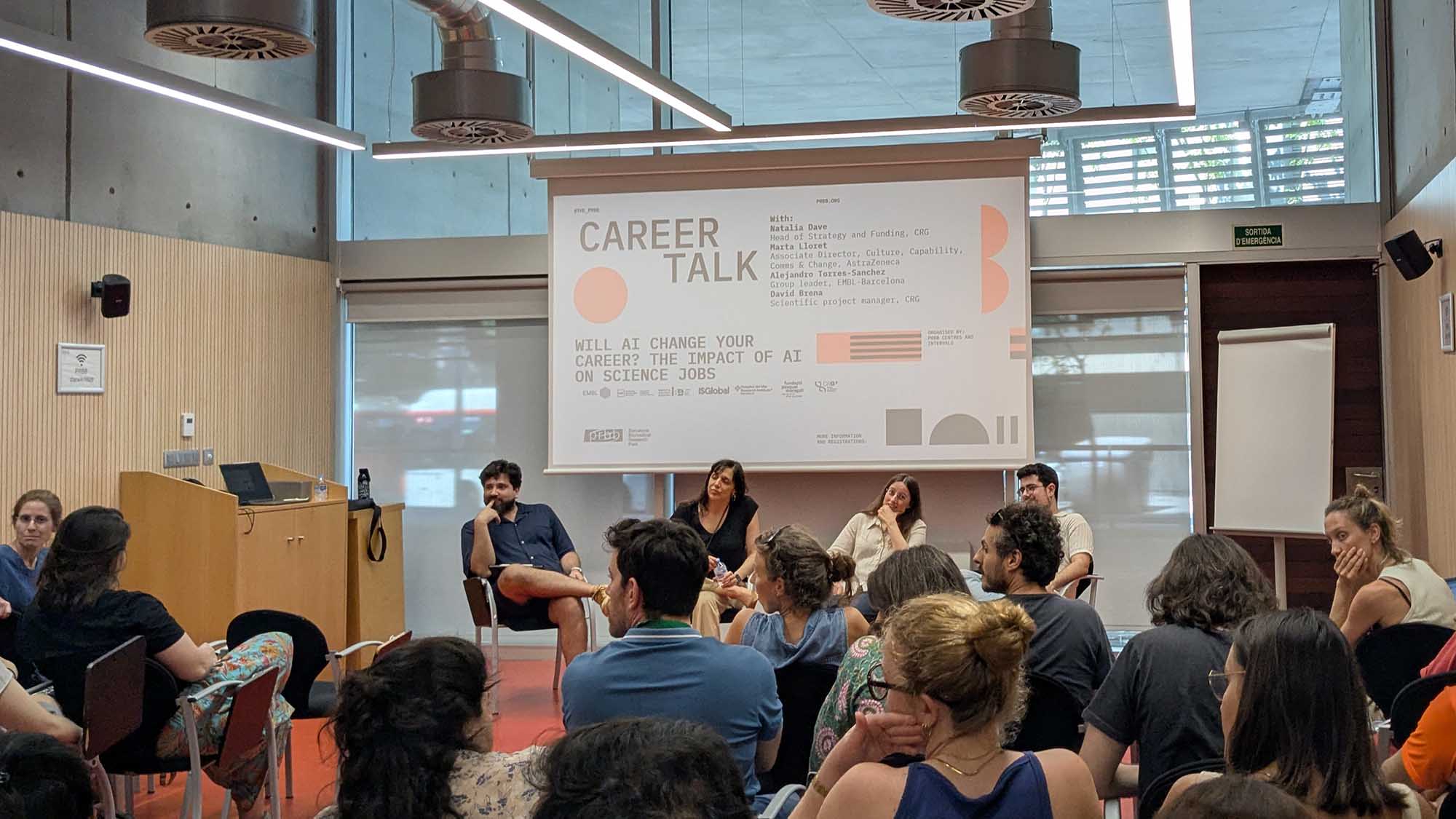
Artificial intelligence is already part of everyday scientific life. It helps to write code, summarise scientific literature, prepare texts, explore data and automate tasks that, until recently, took much longer to complete. But its impact goes beyond productivity. How will work in laboratories change? What skills will those embarking on a scientific career need to acquire? And, above all, what role do institutions play in ensuring this transition is responsible, safe and inclusive?
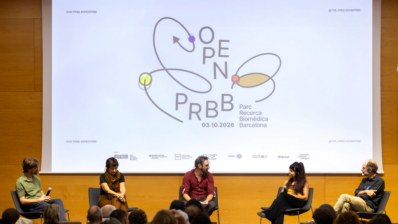
Following the round-table discussion ‘Will AI change your career? The impact of AI on science jobs’ — held as part of Career Month organised by the centres at the Barcelona Biomedical Research Park (PRBB) and Intervals — we spoke to David Brena, the session’s moderator, about how these technologies can transform the way we work in science. For Brena, the question is not just what AI can do, but how to incorporate it without losing critical thinking, expert knowledge or decision-making capacity.
The talk featured Natàlia Dave, Head of Strategy and Funding (SaF) at the Centre for Genomic Regulation (CRG) and EU-LIFE representative for the ERA Action: AI in Science; Marta Lloret, Associate Director, Culture, Capability, Comms & Change at AstraZeneca; and Alejandro Torres-Sánchez, Group Leader at the Barcelona office of the European Molecular Biology Laboratory (EMBL Barcelona). These three speakers, whose professional backgrounds provided different perspectives on AI, covered topics including institutional strategy and European science policy, training, industry, computational research and scientific practice.
David Brena is a senior scientific project manager at SaF, part of the CRG, and is involved in initiatives relating to institutional strategy, talent and transformation, including capacity-building in artificial intelligence, learning and the adoption of new tools. His reflections served as a starting point for putting the speakers’ contributions and the audience’s questions during the session into context.
Although, as David Brena acknowledged at the start of the session, the title of the talk had a somewhat dramatic ring to it, for him the issue goes beyond whether or not AI will eliminate jobs: it is about understanding how it will change the way we work in science. “I don’t think it will replace people, but it will certainly affect how we experience science from almost every perspective”, he explains. He believes this impact will be felt across all roles involved in research: research staff, technical staff, project managers, administrative staff and support teams, amongst others.
During the discussion, this idea was expanded upon with a reflection shared by the speakers: the impact of AI will depend not only on which tasks it can automate, but also on the role human capabilities will play in this new landscape. Natàlia Dave highlighted the risk of losing our judgement if we stop engaging with mentally demanding tasks, whilst Marta Lloret argued for the need to find a new balance between what AI can contribute and what continues to depend on people.
The question is not whether AI will eliminate jobs, but how it will change the way we work in science.
Using AI without switching off critical thinking
Learning to use AI whilst continuing to think One of the ideas that emerged strongly during the session is that it is not enough simply to know that these tools exist or to have tried them out. The challenge is to learn to use them judiciously: to understand when it makes sense to use them, how to provide them with context, how to verify the results, and which parts of the process should not be readily delegated.
Brena emphasises the importance of not accepting AI results at face value without reviewing them, as these tools can generate answers that sound convincing but are not always correct. That is why critical thinking remains essential. AI can help draft an initial version, generate ideas or suggest approaches, but the responsibility for validating, interpreting and making decisions still lies with people.
Scientific judgement is also built on experience, practice and mistakes.
This point is particularly relevant for those embarking on a scientific career. The early use of these tools is not a problem in itself, but it does transform the way we learn, formulate questions and build knowledge. Therefore, rather than discouraging their use, the challenge lies in complementing it with more mindful and critical training. According to Brena, the challenge lies in conveying quality criteria: how to know whether an answer is sound, whether a code is correct, whether an analysis makes sense, or whether a source is reliable.
This concern was also raised by members of the audience at the talk: if we are increasingly automating more aspects of scientific work, how will future generations learn to do science? The debate highlighted that AI can support learning, but that scientific judgement is also built through direct experience, practice and trial and error.
New ways of working in science
AI can change not only the way we learn, but also how tasks are organised within research. In laboratories, automation and AI-based systems could alter the roles of technical staff and researchers. In more computational fields, generative tools are already changing the way we programme, analyse data or visualise results.
Torres-Sánchez provided an insight into the day-to-day workings of a research group. Although AI is not a core technology in his laboratory, it has been incorporated as a support tool for tasks such as writing, translation, preparing proposals, working with mathematical models and programming. As he explained, some programming tasks that might previously have taken weeks can now be completed in a matter of hours.
This ability to support technical processes can also lower the barrier to entry for tasks that previously required more specialised knowledge. Brena compares this change to the impact YouTube has had on learning new skills: whilst tutorials have already broken down many barriers, AI can lower them even further, as it offers personalised assistance tailored to each person’s specific problem.
The automation of processes or tasks does not eliminate the need for expert knowledge.
But that does not diminish the value of expert knowledge. To interpret results, detect errors or decide whether a solution makes sense, it remains essential to understand the underlying scientific problem. AI can speed up processes, but human judgement is key to deciding which questions are worth asking, assessing the results and understanding their implications.
The discussion also prompted reflection on the role of junior researchers. Torres-Sánchez pointed out that PhD students are hard-working, but are also at a formative stage in their careers. Therefore, the challenge is not only to decide what AI can do, but also to determine which experiences remain essential for training in a scientific career.
The role of institutions
AI may also change the way scientific institutions are organised. Brena argues that the adoption of these tools cannot depend solely on the individual initiative of curious or more tech-savvy individuals. Institutions must be responsible for deciding which models can be used, with what data, and under what conditions.
Furthermore, this transition will not proceed at the same pace for everyone. Some people will quickly incorporate these tools into their daily lives, whilst others will need more time, further training or greater reassurance before changing processes that are already working. For Brena, this is one of the responsibilities of institutions: not only to facilitate access to new technologies, but also to support the change without turning it into yet another burden on existing workloads.
In this regard, institutions in the scientific sector are already beginning to take action, drawing up user guides, offering professional licences, promoting in-house training and providing spaces to test tools safely.
Deciding how to work with sensitive data, unpublished results or internal information will become increasingly important.
Dave explained that this transition is already part of the strategies of some centres, such as the CRG itself. She also mentioned the work of EU-LIFE, a European alliance of research centres based at the PRBB, which is helping to develop living guidelines on the ethical use of AI within the framework of the ERA Action dedicated to AI in Science. This European initiative aims to coordinate strategies, capabilities and best practices to integrate artificial intelligence responsibly into research, with the aim of ensuring that the guidelines can be updated as tools evolve and new challenges arise.
This support for research staff also involves deciding how to work with sensitive data, unpublished results or internal information. Consequently, data quality, confidentiality, reproducibility, controlled access to information, and data sovereignty and governance will become increasingly important when incorporating AI into research.
What skills will we need?
When Brena asked during the session what we should learn, try out or avoid delegating to AI, the answers went beyond a list of tools. They did not point to a single technical skill, but rather a combination of curiosity, judgement and adaptability.
Lloret highlighted the importance of maintaining curiosity, experimenting with the tools and understanding where they can help, whilst also recognising their limitations. What we should not readily delegate, she argued, is human judgement and critical thinking. Dave emphasised other skills that may become increasingly important in this new context: imagination, ethics, creativity and, in particular, communication with other people. And Torres-Sánchez insisted that, even as the tools change, expert judgement and mastery of the field of study will still be needed to interpret specific scientific questions, evaluate the answers or spot when something does not add up.
AI can help, but the judgement required to decide and interpret must remain human.
Beyond specific job profiles, the debate pointed to a common idea: AI will require not only technical skills, but also sound judgement. Knowing how to formulate good questions, understanding the limitations of the tools, evaluating results and maintaining a critical eye will be increasingly important skills for anyone working in research.
In this regard, AI could also have a less obvious effect: if many people use the same tools and models, the way we write, think or frame questions may become more uniform. For this reason, the value of diversity in profiles, disciplines and ways of looking at science could become even more important in the coming years.
A transition we can still shape
Rather than offering a definitive answer, the talk served to open up a conversation that is likely to shape the future of research. AI can automate processes, speed up tasks and expand capabilities, but the underlying question remains a profoundly human one: how do we want to work, learn and do science from now on?
The key, according to Brena, is not to wait for change to happen without having thought it through first. “We still have time,” he says. Time to decide how to incorporate these tools, how to train the people who will use them, and what role we want the human perspective to continue to play in science.