
What can we tell about a tumour when we detect it? Why are some harder to treat than others? And what does a patient tell us when we ask how they are doing twenty years after treatment? This November, to mark Movember, we look back at five years of research in which teams from the research centres at the Barcelona Biomedical Research Park (PRBB) have helped answer these questions.
Key points
- Family history and age help us understand prostate cancer risk. Researchers are also studying the role of the environment, but an association does not show that an exposure causes the disease.
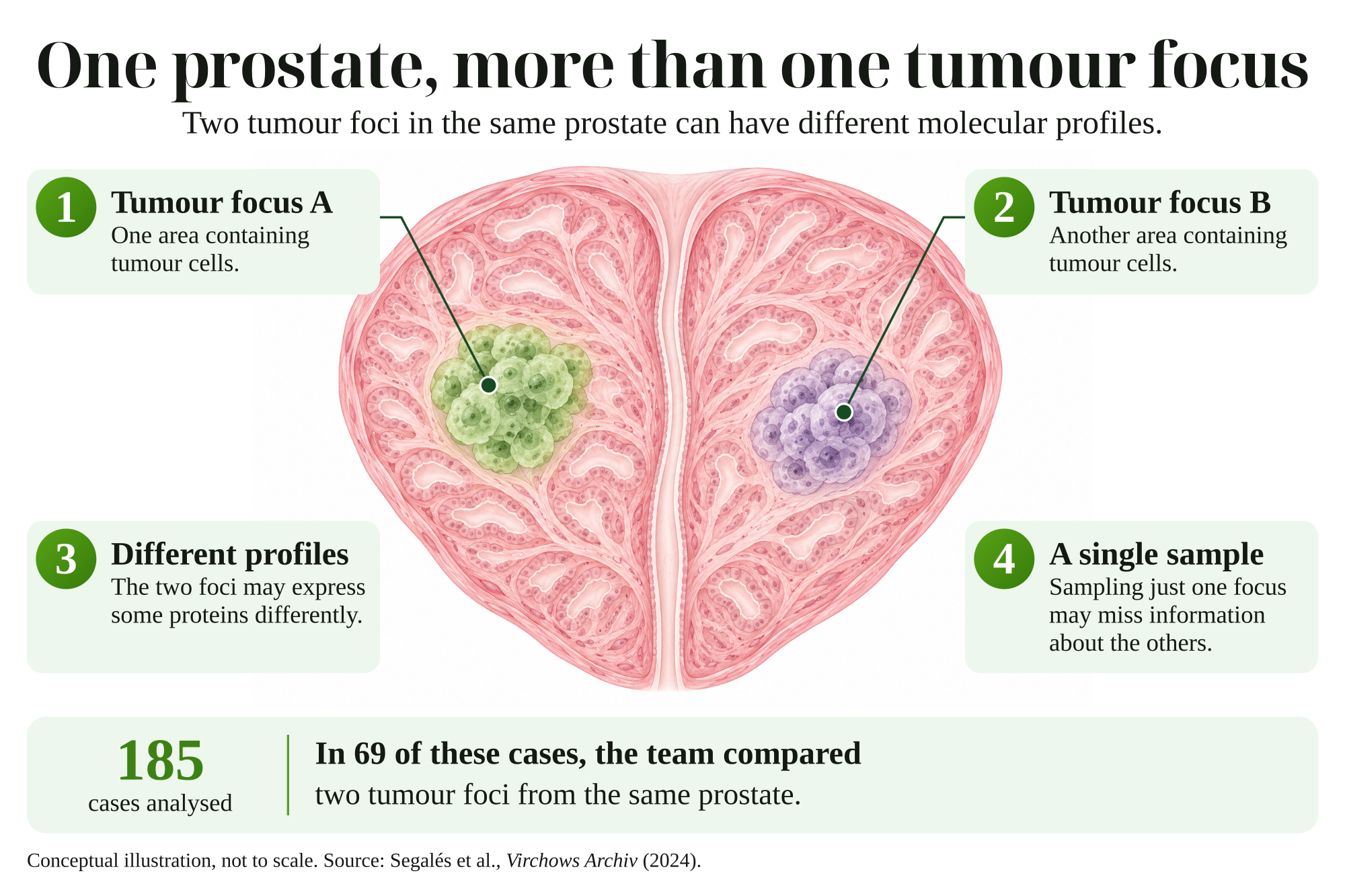
- A single prostate can contain several tumour foci with different molecular features. This makes it harder to predict how the disease will progress and helps explain why researchers are looking for new biomarkers.
- To assess a treatment, we need to know how well it controls the disease and what changes in the daily lives of the people who receive it. Some effects can still be seen up to twenty years later.
What influences the risk of developing prostate cancer?
The risk of developing prostate cancer increases with age and is higher in people with a family history of the disease. Part of this predisposition can be studied using polygenic risk scores, which combine information from many genetic variants. To interpret a score, however, we need to know what values are typical in a reference population.
Arcadi Navarro, head of the Evolutionary Genomics group at the Institute of Evolutionary Biology (IBE, CSIC-UPF), helped interpret the results of a study published in 2025 in the European Journal of Human Genetics. The team used genomic data from 2.190 people of Spanish ancestry to build reference distributions for more than 3.000 scores. These include scores for prostate cancer as well as many other diseases and traits. The atlas shows where a score falls within the population distribution, but it does not validate a test for predicting who will develop the disease.
Understanding risk also means looking at the environment, which calls for different tools. Cristina M. Villanueva, a researcher at the Mar Campus of the Barcelona Institute for Global Health (ISGlobal), is one of the authors of a study on nitrates in drinking water, published in 2023 in Environmental Health Perspectives. The study, with Carolina Donat-Vargas as first author, is part of MCC-Spain, an epidemiological study involving several research centres. The team reconstructed participants’ exposure from where they had lived and the type of water they drank. Comparing 697 cases with 927 controls, they found that a higher estimated intake of nitrates from drinking water was associated with a greater likelihood of prostate cancer. The association was stronger for aggressive tumours.
In another MCC-Spain study, published in 2026 in Environmental Research, Manolis Kogevinas, affiliated with the Barcelona Institute for Global Health (ISGlobal) and the Hospital del Mar Research Institute (HMRIB), and Gemma Castaño-Vinyals, from ISGlobal, collaborated with a team from the Instituto de Salud Carlos III. An association with prostate cancer, particularly advanced disease, was found when arsenic was measured in toenails, but not when it was measured in urine. The two types of sample may reflect different periods of exposure. As with nitrates, the findings point to a possible link that warrants further investigation. Neither study establishes that these exposures cause prostate cancer.
Detecting a tumour does not always tell us how it will progress
PSA, or prostate-specific antigen, is a protein that can be measured with a blood test. A raised PSA level can be a sign of cancer, but it can also occur when the prostate is enlarged for benign reasons. European guidelines on prostate cancer place PSA testing within a wider assessment that also considers whether an MRI scan and a biopsy are needed. If a tumour is confirmed, its grade and stage help guide the decision. The grade describes how different the cells look from normal cells under the microscope, while the stage describes how far the tumour has spread. For some low-risk, localised tumours, this may mean opting for active surveillance and reserving treatment for when there are signs of progression.
The sample that is analysed, however, does not always tell the whole story. Silvia Hernández-Llodrà and Josep Lloreta-Trull designed and supervised a study on this question, with Laura Segalés as first author. All three list the Department of Medicine and Life Sciences at Pompeu Fabra University (MELIS-UPF) as an affiliation. Lloreta-Trull and Nuria Juanpere, a co-author, also list the Department of Pathology at Hospital del Mar. In a study published in the 2024 volume of Virchows Archiv, they analysed five proteins in samples from 185 cases. In 69 cases with more than one tumour focus, they were able to compare the dominant focus with a secondary one. In some cases, the two foci had different molecular profiles.
Some patterns were associated with an earlier rise in PSA after treatment, a sign known as biochemical recurrence. A rise in PSA does not necessarily mean that the cancer has spread.
The question of how far a tumour has spread also arises during surgery. Lluís Fumadó, a urologist at Hospital del Mar and a collaborating researcher at HMRIB, coordinated a European trial on sentinel lymph node detection, published online in 2023 in European Urology Focus. Fumadó and José María Abascal also list MELIS-UPF as an affiliation. The probe helped locate at least one of the first lymph nodes to receive drainage from the tumour in all 27 patients assessed. Finding one of these nodes, however, does not rule out the presence of tumour cells in other nodes. The trial primarily assessed how well the probe worked.
From DNA to RNA, what can the tumour’s biology tell us?
One way to understand these differences is to study what happens to the genes involved in DNA repair. Laura Segalés and Silvia Hernández-Llodrà, from MELIS-UPF and HMRIB, worked with colleagues from HMRIB’s Urological Cancer Research Group (GRECU), coordinated by Joaquim Bellmunt, to analyse 121 primary tumours in a study published in 2025 in Laboratory Investigation. They found that loss of copies of PARP1 and gain of copies of PARP2, two genes involved in DNA repair, were associated with features of more aggressive disease. Tumours with a gain in PARP2 copy number alone had the shortest time to a further rise in PSA.
In a 2026 study in Molecular Biology Reports, Segalés and Hernández-Llodrà and other members of the group found that the relationship between another marker, ETS2, and the time until PSA rose again varied depending on how the p53 protein was detected in the samples. Both studies point to potential prognostic markers, or clues to how the disease might progress. Whether they provide enough information to guide decisions in clinical practice remains to be seen. Meanwhile, GRECU has completed a project on the role of PARP1 and PARP2 in metastatic hormone-sensitive cancer, supported by the Asociación Española de Urología.
But the DNA sequence is only part of the story. When a cell copies a gene into RNA, it can join the pieces it keeps in different combinations. This process, known as alternative splicing, allows a single gene to produce different versions of RNA.
Malgorzata Rogalska and Juan Valcárcel, both from the Centre for Genomic Regulation (CRG), contributed to a study on the regulation of splicing, published in 2026 in Nature. The team showed that polyamines, molecules that cells naturally produce, can alter how RNA is processed by protecting parts of the proteins involved. The models included human prostate cancer cells. The findings explain a link between metabolism and gene regulation, but do not show that the mechanism can be used to treat the disease.
When does combining treatments help?
Many prostate tumours rely on signals from androgens, hormones such as testosterone, to grow. In advanced disease, these hormones can be reduced or their signals blocked. If the tumour progresses even though testosterone remains at very low levels, the cancer is described as castration-resistant.
Alejo Rodríguez-Vida, an oncologist at Hospital del Mar and a researcher in GRECU at HMRIB, co-authored the final PEACE-3 results, published in 2026 in Annals of Oncology. The international phase III trial, coordinated by the European Organisation for Research and Treatment of Cancer (EORTC), studied patients with metastatic castration-resistant disease and bone metastases. Median survival was 38,2 months with enzalutamide and radium-223, and 32,6 months with enzalutamide alone. However, high-grade adverse events were also more common with the combination.
Rodríguez-Vida also contributed to ZZ-FIRST, published in 2026 in Nature Medicine. This phase II trial, conducted at eight centres in Spain and sponsored by MEDSIR, included 54 patients with extensive metastatic disease that was still sensitive to hormone treatment. Both groups received androgen deprivation therapy. Adding talazoparib to enzalutamide met the PSA response threshold set as the primary endpoint. However, the comparison between groups was exploratory and did not establish a clear additional clinical benefit. High-grade toxicity was also more common with the combination. The two trials looked at different situations. ZZ-FIRST illustrates why a PSA response alone does not establish a benefit for patients.
What is life like twenty years after treatment?
An outcome that matters to a patient can be as simple as being able to sleep again without getting up several times to urinate. Other changes affect continence, sexual function or bowel symptoms. Questionnaires that patients fill in allow researchers to study these effects directly and see whether they change over time.
Víctor Zamora, Olatz Garin and Montse Ferrer, from the Health Services Research Group at HMRIB, and their colleagues used these questionnaires in a study published in 2024 in Clinical and Translational Radiation Oncology. They compared the first two years of active surveillance, robotic surgery, intensity-modulated external beam radiotherapy and brachytherapy, a technique that delivers radiation from within the prostate. The pattern of symptoms differed between groups. Robotic surgery was associated with more urinary incontinence than active surveillance, while bowel symptoms were more common in the radiotherapy and brachytherapy groups.
In another study, published in 2025 in European Urology Open Science, Zamora, Garin and Ferrer followed a separate cohort of patients with localised cancer for up to twenty years after treatment. Some differences persisted to the end of follow-up. Urinary incontinence had worsened more among patients who had undergone open surgery, while sexual function had declined less in the brachytherapy group. Because treatments were not assigned at random, some of the differences may reflect how the groups differed at the outset. These findings do not show that one treatment is better for everyone, but they help patients ask more specific questions before making a decision.
With this in mind, the research project on shared decision-making led by Montse Ferrer at HMRIB, funded by the Instituto de Salud Carlos III and the Asociación Española Contra el Cáncer, has led to an app that is being tested to help patients consider treatment options with their medical team. The team has also contributed to TrueNTH, an international registry of prostate cancer outcomes funded by Movember, which makes it possible to study quality of life and care across countries.
Find out more
- PSA and other blood markers. Manolis Kogevinas and Gemma Castaño-Vinyals, from ISGlobal, contributed to a study on a variant of the gene that encodes PSA, published in 2024 in Nature Communications, and took part in an MCC-Spain study on circulating microRNAs, published in 2025 in Scientific Reports.
- Other environmental exposures. Kogevinas and Castaño-Vinyals took part in a study on proximity to industrial facilities, published in 2024 in Science of the Total Environment. It found no overall association with prostate cancer. El·lipse also covered research on occupational heat exposure, published in 2023 in Environmental Research, with contributions from Michelle C. Turner at ISGlobal. The study found no clear association with prostate cancer risk.
- Other ways to study tumours. Miquel Anglada-Girotto, Carolina Segura-Morales and Luis Serrano, from the CRG, contributed to a method for studying the activity of splicing factors, published in 2026 in Nature Communications. Guim Aguadé-Gorgorió and Ricard Solé, affiliated with the IBE, and José Costa, from Yale University, proposed a framework for studying tumours from an evolutionary perspective, published in 2023 in BioEssays. These studies provide context rather than focusing specifically on the prostate.
- How do we measure the effects of treatment? Olatz Garin and Montse Ferrer, from HMRIB, helped design a study comparing radiotherapy techniques using patient-reported outcomes, published in 2026 in the World Journal of Clinical Oncology. Ferrer also contributed to an economic evaluation of treatments with ten years of follow-up, published in 2025 in the European Journal of Cancer Care.
- Staging and locating a recurrence. Lluís Fumadó, together with José María Abascal, Nuria Juanpere and Lluís Cecchini, took part in a study on sentinel lymph node biopsy, published in 2022 in Frontiers in Medicine. Fumadó also co-authored a study with the Radiation Oncology and Nuclear Medicine departments at Hospital del Mar on PSMA-targeted PET after surgery, published in 2025 in Cancers. Pedro Plaza and Juan Sebastian Blanco, from Nuclear Medicine at Hospital del Mar, contributed to a follow-up study on how this type of imaging can change radiotherapy planning, published in 2026 in Cancers.
- Active surveillance in clinical practice. Lluís Fumadó, from GRECU and the Department of Urology at Hospital del Mar, also took part in an analysis of a Spanish active surveillance registry, published in 2025 in Cancer Medicine.
- Measuring quality of life accurately. Víctor Zamora, Olatz Garin and Montse Ferrer, from HMRIB, took part in the validation of the Spanish version of a prostate cancer-specific quality-of-life questionnaire, published in 2023 in the World Journal of Urology.
- What can an international registry tell us? Olatz Garin and Montse Ferrer, from HMRIB, also contributed to a TrueNTH study on variations in surgical care, published in 2024 in JCO Global Oncology. HMRIB explains how the former IMIM coordinated Movember’s international project on quality of life after prostate cancer in Spain.
Carmona, R. et al. (2026, publicat en línia el 2025). The Spanish Polygenic Score reference distribution: a resource for personalized medicine. European Journal of Human Genetics.
Donat-Vargas, C. et al. (2023). Long-Term Exposure to Nitrate and Trihalomethanes in Drinking Water and Prostate Cancer: A Multicase–Control Study in Spain (MCC-Spain). Environmental Health Perspectives.
Varea-Jiménez, E. et al. (2026). Association between arsenic levels in toenails and urine and prostate cancer risk: Findings from the MCC-Spain study. Environmental Research.
Segalés, L. et al. (2024, publicat en línia el 2023). Immunohistochemical markers as predictors of prognosis in multifocal prostate cancer. Virchows Archiv.
Everaerts, W. et al. (2024, publicat en línia el 2023). A Multicentre Clinical Trial Evaluating a Drop-in Gamma Probe for Minimally Invasive Sentinel Lymph Node Dissection in Prostate Cancer. European Urology Focus.
Segalés, L. et al. (2025). Prognostic Value of PARP1 and PARP2 Copy Number Alterations in Prostate Cancer. Laboratory Investigation.
Segalés, L. et al. (2026). Uncovering the role of ETS2 in prostate cancer pathogenesis: relationship with p53 and ERG. Molecular Biology Reports.
Zabala-Letona, A. et al. (2026). Polyamine-dependent metabolic shielding regulates alternative splicing. Nature.
Gillessen, S. et al. (2026). Final overall survival results from EORTC 1333/PEACE-3 trial of enzalutamide plus radium-223 in metastatic castration-resistant prostate cancer. Annals of Oncology.
Zacchi, F. et al. (2026). Talazoparib plus enzalutamide in high-volume metastatic hormone-naive prostate cancer: a randomized phase 2 trial. Nature Medicine.
Zamora, V. et al. (2024). Comparative effectiveness of new treatment modalities for localized prostate cancer through patient-reported outcome measures. Clinical and Translational Radiation Oncology.
Zamora, V. et al. (2025). Twenty-year Patient-reported Outcomes After Surgery, Radiotherapy, or Brachytherapy for Localized Prostate Cancer. European Urology Open Science.