When we talk about biomedical research, we often think of discoveries, laboratories and researchers. But for science to happen, much more is needed: well-prepared spaces, technical services, shared platforms, maintenance, project management, administration and a community able to work in a coordinated way.
This is one of the ideas that the Barcelona Biomedical Research Park (PRBB) wanted to highlight during the celebration of its 20th anniversary. Rather than simply looking back to commemorate the path travelled so far, the anniversary has opened up a very timely question: what does biomedical research need today in order to keep moving forward?
The PRBB currently brings together 7 research centres and a critical mass of nearly 1,700 people. But a very important part of this community does not only correspond to the most visible research profiles, such as principal investigators or postdoctoral researchers. In fact, around 70% of the people working at the park carry out roles linked to areas such as scientific infrastructures, project management, maintenance, scientific and technical services or administration. In other words, they are part of the structure that allows research projects to be carried out every day.
“Behind every discovery there is an enormous human and technological structure that is essential to make research possible”
Jordi Camí, Director General of the PRBB.
A model based on sharing
When the PRBB opened its doors in 2006, the model of bringing independent centres together in the same building, with shared spaces, services and infrastructures, was still not as common as it is today in major scientific environments. The idea, simple but unusual at the time, began to take shape in the late 1980s: to create a space where institutions linked to biomedical, university and hospital research could coexist and foster collaborations naturally.
Twenty years later, this model of coexistence between centres remains one of the park’s main distinctive features. The centres maintain their scientific and institutional autonomy, but share 18 technological platforms, including proteomics, mesoscopy and cryopreservation; cross-cutting programmes such as Intervals, the PRBB’s transversal training programme; and several inter-centre committees, including those on Good Scientific Practice, Equality, Diversity and Inclusion, Biosafety and Sustainability.
According to Reimund Fickert, Director of Communications and Institutional Relations at the PRBB, this way of working has helped create a culture of its own.
“For twenty years, the PRBB has been experimenting with an idea that seems obvious today but was very unusual at the time: sharing spaces, services, technology and scientific culture between independent institutions. This radical collaboration is probably what best explains the park’s identity”
Reimund Fickert, Director of Communications and Institutional Relations at the PRBB
The invisible infrastructure of science
Over these two decades, biomedical research has become more technological, more digital and more dependent on highly specialised platforms. At the PRBB, this change can be clearly seen in the evolution of specialised technical staff, who have gone from representing 14% of the community in 2007 to 37% today.
This transformation shows that excellent research does not depend only on attracting scientific talent, but also on having technical environments able to support increasingly complex projects. Scientific platforms, scientific and technical services, animal facilities, digital infrastructures, prototyping spaces and safety systems form part of an ecosystem that is often absent from the public narrative of science, but is essential for research to move forward.
One example is the μFabLab, a space promoted jointly by the European Molecular Biology Laboratory Barcelona (EMBL Barcelona), the Centre for Genomic Regulation (CRG), Pompeu Fabra University (UPF) and the PRBB to facilitate the development and prototyping of new experimental tools adapted to research needs.
“Increasingly, research needs flexible spaces where biology, engineering and technology can work together”
Oliver Blanco, Director of Infrastructures at the PRBB.
For Blanco, the challenge is for these environments to be able to evolve without interrupting scientific activity. “Science evolves very quickly and infrastructures must evolve with it without stopping research activity”, he says.
This same idea is shared by Joan Antoni Fernández, Director of the PRBB animal facility, who argues that “scientific platforms need constant updating if you want to maintain a competitive environment for international research”.
In parallel, the park is undergoing technical and energy renewal processes, while also looking towards new spaces such as the future PRBB Ciutadella, linked to the new campus on the site of the former Mercat del Peix.
Preparing for a science we do not yet know
If the last 20 years have shown us anything, it is that science changes faster than we are often able to anticipate. In 2006, many of the tools that are now part of everyday life in laboratories, from large-scale data analysis to new digital technologies, either did not yet exist or did not have the prominence they have today.
For this reason, the PRBB avoids speaking about the future as if it were a fixed path. Rather, the challenge is to build infrastructures and services that are flexible enough to adapt to transformations that we cannot yet fully foresee.
In this context, artificial intelligence (AI) is emerging as one of the major drivers of change. According to Camí, AI is already beginning to intervene in processes that until recently seemed to be reserved exclusively for human judgement, such as the formulation of hypotheses, the analysis of complex data or the generation of scientific content.
“Trying to resist this transformation is useless”, he says. For this reason, he argues that the major challenge is the ethics and regulation of AI: “We will need to establish legal and ethical frameworks to reach consensus as soon as possible and understand how we can use these tools to accelerate scientific knowledge with responsible AI”.
A community designed to grow
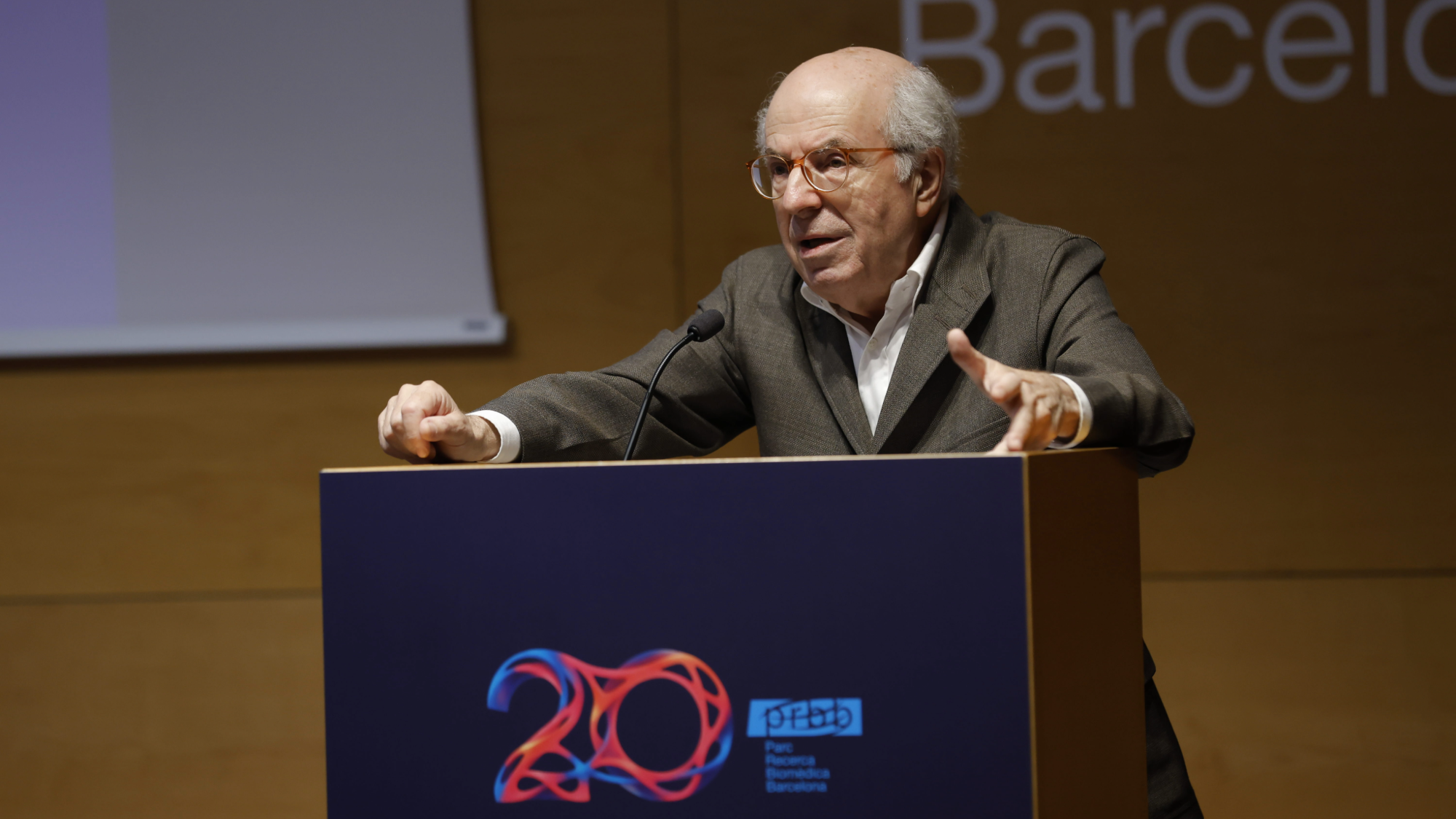
The PRBB’s 20th anniversary was commemorated on 20 May with an institutional event in the park’s Auditorium, hosted by journalist Núria Dias and attended by political and scientific representatives, including the vice-chancellor of Pompeu Fabra University, Laia de Nadal; the Mayor of Barcelona, Jaume Collboni; and the Catalan Minister for Research and Universities, Núria Montserrat.
The event combined institutional speeches, commemorative videos and perspectives from within the PRBB scientific community. After the welcome and the intervention by the Mayor of Barcelona, Jordi Camí outlined the park’s main challenges in this new stage. The celebration also included videos featuring the directors of the PRBB centres, as well as contributions from Montserrat Coll, from EMBL Barcelona, and Joana Porcel, from ISGlobal, who brought the perspective of the centres that form part of the ecosystem.
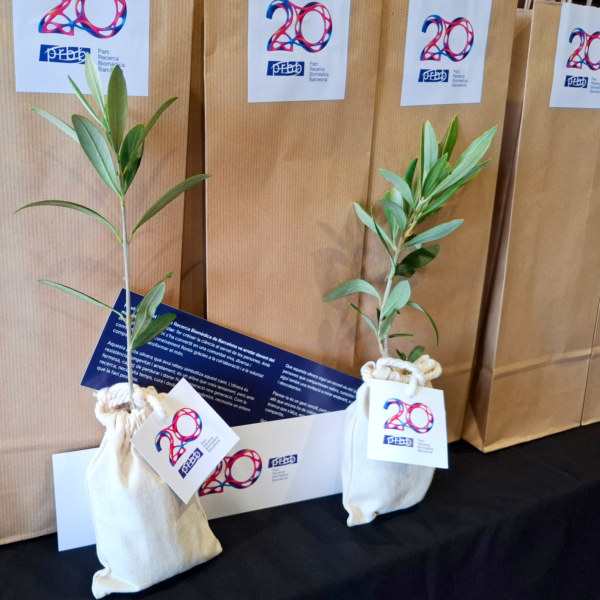
The commemoration ended with the gift of a small olive tree to attendees, a symbol of the model the park wants to champion: science needs time, care and an environment that makes it possible.
“Research, like an olive tree, needs time, care and an environment that makes it possible. What we have built over these twenty years is precisely that: a community designed to grow and endure”
Jordi Camí, Director General of the PRBB.
The full event will be available to watch on the PRBB YouTube channel, where the SomPRBB video, a commemorative piece dedicated to the people who make up the park’s community, will also be available.