
Once a person is infected with human herpes simplex virus type 1 (HSV-1), they carry the virus for life. It is estimated that around 3.8 billion people under the age of 50 worldwide are infected with this HSV-1. In most cases, the infection is asymptomatic or causes recurrent cold sores. However, in immunocompromised individuals or infants, it can lead to serious complications such as blindness or even be life-threatening. Consequently, its high prevalence in the global population presents a challenge to global health that must be addressed.
Now, a recent study by the Centre for Genomic Regulation (CRG) has uncovered one of the mechanisms that HSV-1 uses to replicate inside human cells. The study shows that the virus is can precisely remodel the three-dimensional structure of the human genome in order to access the regions most useful to it and make better use of the host’s resources.
“HSV-1 is an opportunistic interior designer that remodels the human genome with great precision and chooses which parts it comes into contact with. This is a new manipulation mechanism that we did not know the virus ued to exploit the host’s resources”
Esther González Amela
The team has also found that when topoisomerase I—an enzyme that helps relieve DNA tension during key processes of transcription and genome organisation— is innactivated, HSV-1 loses its ability to replicate.
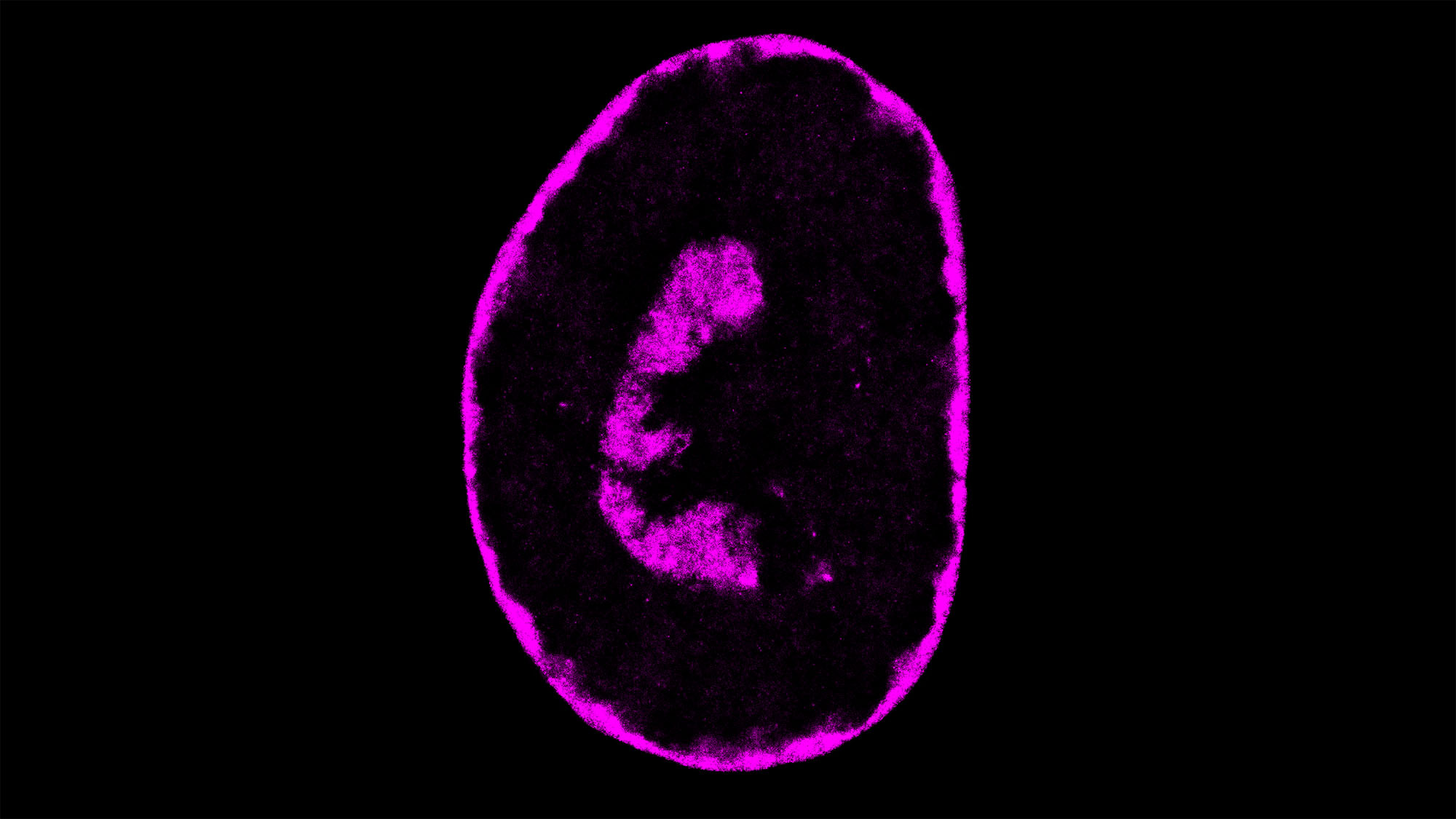
The image shows how the human genome becomes compacted within the cell after infection with the herpes virus. It was obtained by combining super-resolution microscopy, which makes it possible to observe structures as small as 20 nanometres, with Hi-C, a technique that reveals which DNA fragments come into contact within the nucleus.