Quan un insecte passa de juvenil a adult, no només canvia d’aspecte, també canvia el programa de desenvolupament que guia el seu cos. Però, com sap un organisme que ha arribat el moment de deixar enrere l’estat juvenil i convertir-se en adult?
Dos estudis recents de l’Institut de Biologia Evolutiva (IBE, CSIC-UPF) aborden aquesta qüestió en la panerola alemanya, Blattella germanica. El primer se centra en els mecanismes genètics que mantenen l’estat juvenil i en els que desencadena la metamorfosi. El segon, aporta una nova eina per veure on actuen certes proteïnes durant el desenvolupament.
Llegits junts, expliquen molt bé com avança la recerca entenent millor els mecanismes biològics i, alhora, trobant maneres més fines d’observar-los.
Key points:
- lattella germanica is a good model for studying metamorphosis.
- Chinmo and Abrupt reinforce the genetic control of the juvenile state.
- A second study makes it possible to observe proteins in vivo using fluorescence.
- Together, both studies help us better understand how metamorphosis is regulated.
Why a cockroach
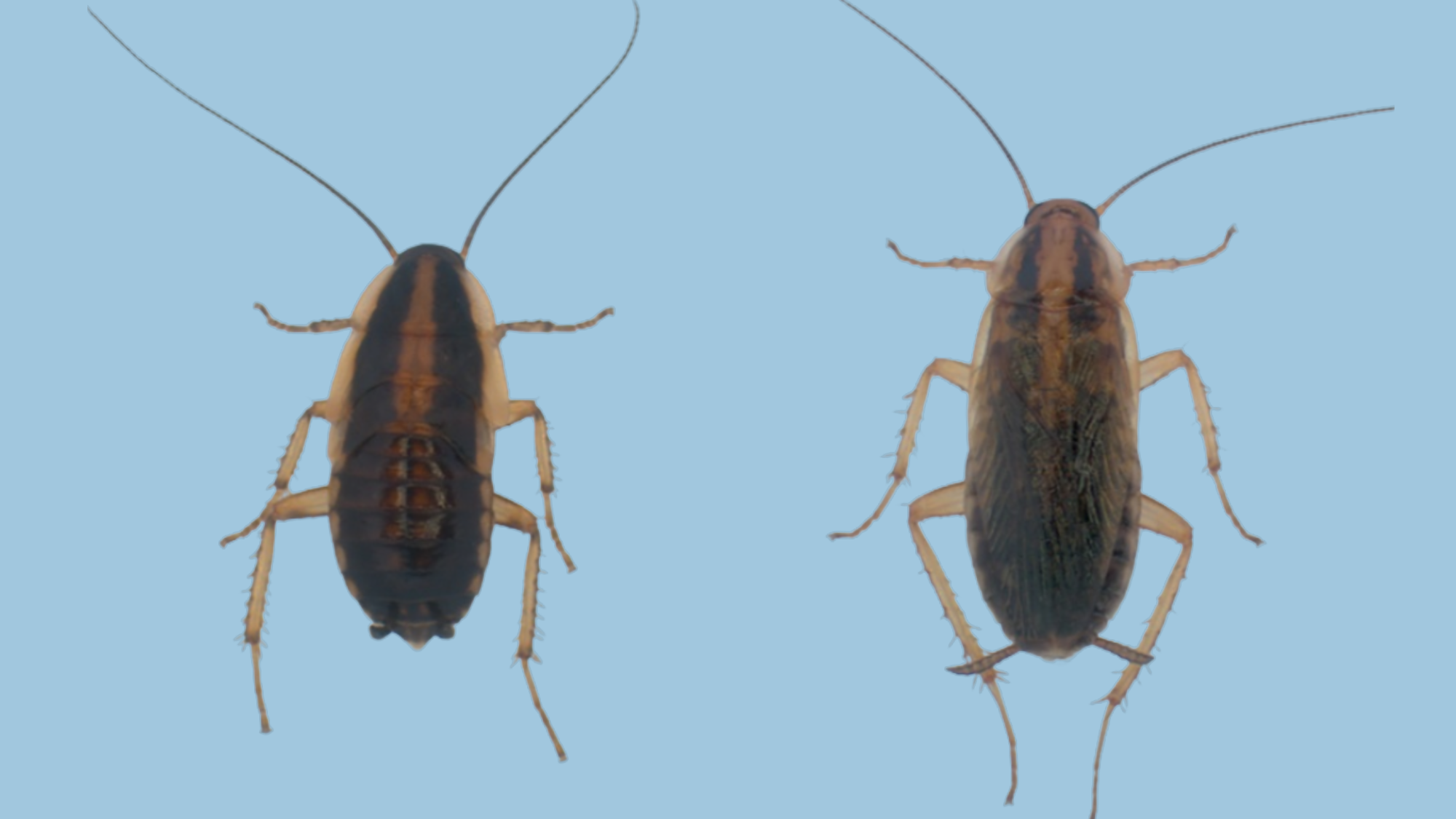
Metamorphosis is one of the most striking processes in the insect world. But when we imagine wings appearing and bodies being reorganised, we tend to think of a butterfly rather than a cockroach. Yet the cockroach Blattella germanica is actually a very useful model for studying it. As Xavier Bellés, principal investigator of the Evolution of Insect Metamorphosis Lab at the Institute of Evolutionary Biology (IBE, CSIC-UPF), explains, the reason is that it has a simple, or hemimetabolous, metamorphosis, in which the nymph resembles the adult and there is no pupal stage. By contrast, other insects, such as butterflies, have a complex, or holometabolous, metamorphosis, with a pupal stage.
As Xavier Bellés points out, this makes Blattella germanica an ideal candidate for studying what the regulatory mechanisms of metamorphosis may have looked like in an ancestral insect. In other words, if you do not know the starting point well, you cannot understand how the evolutionary transition towards complete metamorphosis took place
A pathway more robust than it seemed
For years, much of what we know about the regulation of metamorphosis in insects has been explained through the MEKRE93 pathway. Put simply, it works like this: while juvenile hormone is present, Kr-h1 is activated, maintaining the juvenile state by repressing E93, the gene that promotes adult development. When juvenile hormone drops at the end of the juvenile stage, Kr-h1 also drops, E93 is released, and metamorphosis begins.
The new study, published in PLOS Genetics and led by Xavier Bellés’ group, shows that this scheme was correct, but incomplete. The team looked in greater detail at the role of two more genes, Chinmo and Abrupt, in Blattella germanica. The results indicate that Chinmo also helps maintain the juvenile state by repressing E93. Abrupt, by contrast, acts by reinforcing Kr-h1, which is what holds metamorphosis back. This means that control of the transition from juvenile to adult does not depend only on a simple axis between Kr-h1 and E93, but on a more robust system than previously thought.
When the team reduced chinmo expression in fourth-instar nymphs, the insects underwent precocious metamorphosis and reached an adult form too early. In addition, these adults were smaller and, in 69% of cases, had poorly unfolded wings and tegmina. This reinforces the idea that it is not enough simply to “switch on the adult programme”. The “juvenile programme” also has to be maintained for long enough for development to proceed properly. Metamorphosis, then, is not only a matter of changing, but of changing at the right time.
The authors propose that key regulatory factors such as Kr-h1, Chinmo, Abrupt, BR-C and E93 were already present in insects with simple metamorphosis and were later reorganised, giving rise to insects with complete metamorphosis.
From genetic control to a new tool to observe it
The second study was led by the group of Maria Dolors Piulachs Bagà, principal investigator of the Insect Reproduction Lab at the Institute of Evolutionary Biology (IBE, CSIC-UPF), and published in Cell Reports Methods. The study provides a tool to explore the regulatory map of metamorphosis in a more direct way. For the first time, the team has managed to insert a gene into Blattella germanica in a stable and heritable manner and use it to visualise a protein through fluorescence.
The advance is based on DIPA-CRISPR, a technique the group had already helped develop in 2022. One of the difficulties with this species is that its eggs cannot easily be manipulated at very early stages, because they are protected by a rigid structure. With this system, however, the work is carried out through adult females while the eggs are forming.
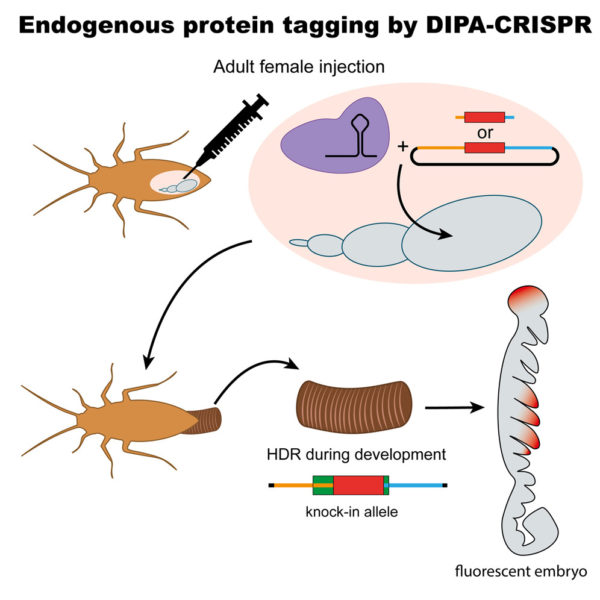
Initially, this strategy made it possible to eliminate the expression of a gene. It has now gone a step further: adding a fluorescent tag to a gene of interest in order to see where the protein is expressed inside the living organism. To do so, the team fused the gene distal-less, important in embryonic development, with the fluorescent marker mCherry. The result is a new tool for observing more clearly what happens inside the embryo and in which tissues certain proteins act.
Two advances addressing the same question
Although these two studies may seem disconnected, they are in fact two advances addressing the same question from different angles. On the one hand, the work by Xavier Bellés and his team adds new pieces to the genetic control of metamorphosis. On the other, the work by Maria Dolors Piulachs and her team provides a tool to observe these processes more clearly in vivo. Taken together, both studies help us better understand the biological mechanisms of metamorphosis and how the tools for observing them are improving.
Read also:
Escudero, J., Gonzalvo, J., Piulachs, M.-D., & Belles, X. (2025). Chinmo function in cockroaches provides new insights into the regulation and evolution of insect metamorphosis. PLOS Genetics, 21(12), e1011993. https://doi.org/10.1371/journal.pgen.1011993
Ferrández-Roldán, A., & Piulachs, M.-D. (2026). Using DIPA-CRISPR for simple and efficient endogenous protein tagging in insects. Cell Reports Methods, 101297. https://doi.org/10.1016/j.crmeth.2025.101297