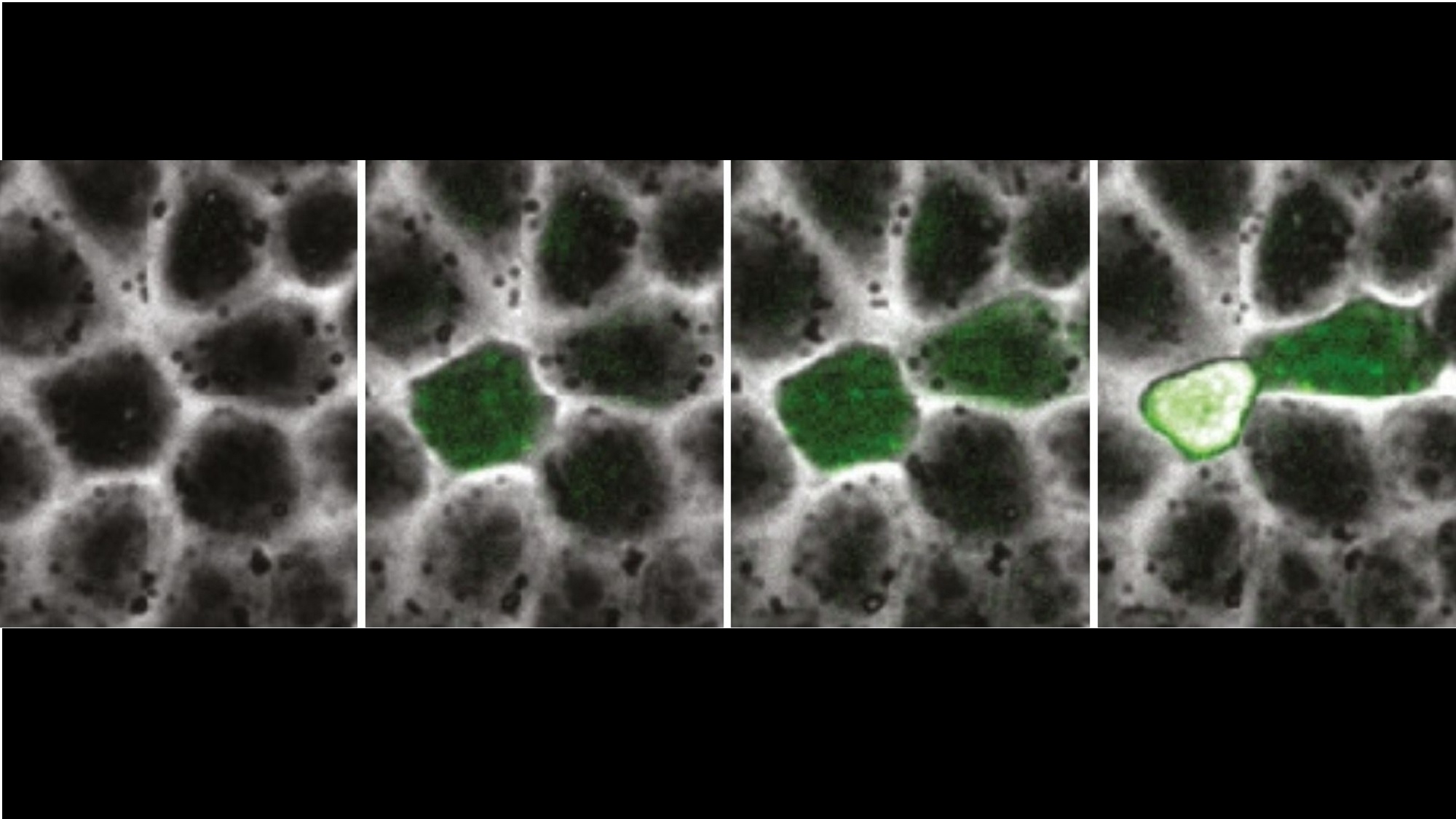
Our body’s epithelia (the layers of cells that line our skin, intestines or lungs and that function as a barrier and for the absorption of gases or nutrients) are constantly renewed. Until now it was known that when an epithelium is too compressed, the excess cells are expelled through a process of controlled death called cell extrusion; but it was not known what caused a cell to be expelled while its neighbor was not.
A new study demonstrates that the mechanical forces derived from compression in the epithelium activate an electric current that opens the sodium channels, and that when sodium inters the cell, it depolarizes the membrane. Cells with enough energy manage to pump sodium outwards and repolarize, but those with energy deficits do not: they lose volume and are expelled.
This finding, led by Jody Rosenblatt at The Francis Crick Institute and King’s College London and with the participation of Carlos Pardo-Pastor at the Department of Medicine and Life Sciences, Pompeu Fabra University (MELIS-UPF), reveals that epithelia depend not only on mechanical signals, but also on a “electrical quality control” that acts as a sensor capable of identifying weak cells and eliminating them.
The research is important because it offers a possible explanation for the link between poor eating habits and increased risk of cancer. If the excessive caloric intake interferes with this low-energy sensor, it could hinder the elimination of defective cells and promote their accumulation, a typical phenomenon in tumors. In addition, the mechanism could help to understand other pathological processes, such as tissue damage after energy deprivation events, for example in vascular accidents.
Mitchell, S.J., Pardo-Pastor, C., Tchoumakova, A., Zangle, T.A., Rosenblatt, J., 2025. Energy deficiency selects crowded live epithelial cells for extrusion. Nature. https://doi.org/10.1038/s41586-025-09514-w