The Barcelona Biomedical Research Park (PRBB) is a 55.000 m² building that houses eight research centres and more than 1.700 people, where scientific activity is intense and constant. In such an environment, energy demand is very high. Aware of this challenge, the commitment to sustainability is part of the values that guide the actions of the PRBB Consortium, which manages the building.
In this article, we review the main efficiency measures implemented in recent years, the projects planned for the medium and long term, and the key role of the Park community in moving towards an increasingly sustainable PRBB.
A unique building, high energy demand
Activity at the PRBB is constant and, as is the case with many scientific infrastructures, a significant part of energy consumption is associated with essential requirements for research: ventilation and air filtration, cooling and deep-freezing equipment, instrumentation, technical rooms, etc.
The measures adopted in recent years in different areas have contributed to a progressive reduction in energy, gas and water consumption, consolidating a downward trend.
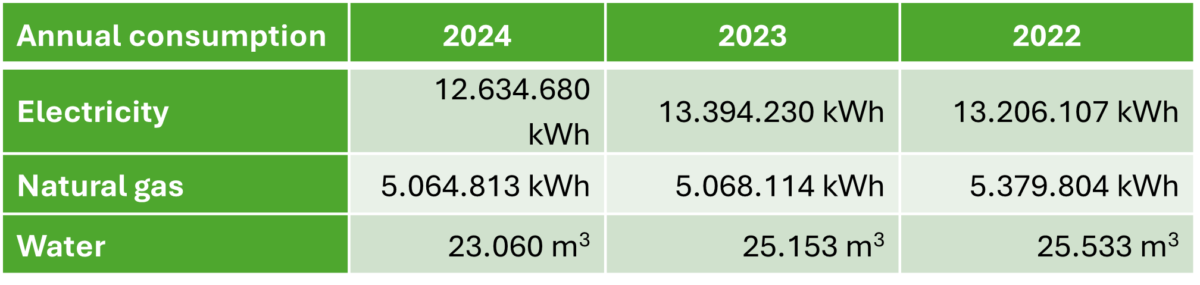
However, to better understand this evolution, we need to analyse how the Park’s energy demand is configured. A distinction must be made between two major sources of demand:
- Around 70% of consumption is linked to scientific activity and its technical requirements. In this area, the PRBB has a Sustainability Board where research centres and internal participation bodies work together to promote good practices, share criteria and raise awareness to help optimise the use of resources without compromising the safety and quality of research.
- The remaining 30% corresponds to infrastructure operation. In this case, it is the infrastructure manager, the PRBB Consortium, which is responsible for promoting actions aimed at maintaining, updating and optimising equipment to improve its energy efficiency.
Recent actions and improvements to the infrastructure
In recent years, multiple actions have been carried out to improve the building’s energy efficiency and reduce associated emissions. Some of these are:
- Installation of photovoltaic panels: 174 photovoltaic panels have been installed, covering an area of 350 m². This installation allows for savings of approximately 100.000 kWh per year and a reduction of 10,9 tonnes of CO₂.
- Replacement of lighting with LEDs: nearly 12.000 light fixtures have been replaced throughout the building, with an estimated saving of 800.000 kWh per year and a reduction in CO₂ emissions of 320 tonnes.
- Optimisation of the data centre: the old cooling machines using refrigerant gas have been replaced with six new water-based machines, which are more efficient and sustainable.
- Improved water management in laboratories: between 2020 and 2025, new type 1 and 2 water purification equipment has been installed. These new systems have a 60% efficiency rating (compared to 10% for the previous equipment), and surplus water is reused in the toilet circuit, thus avoiding waste.
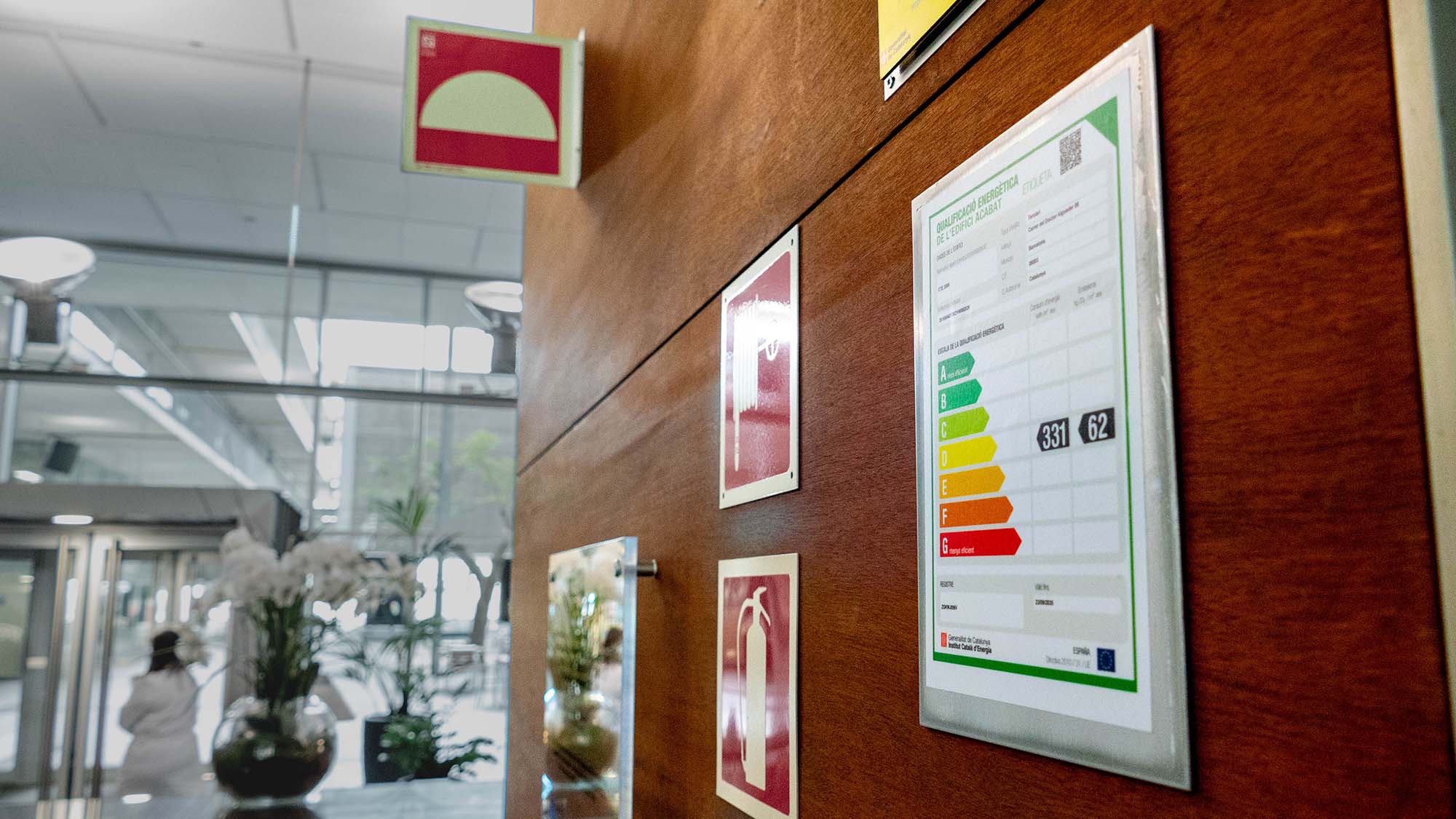
Together, these actions, added to those already carried out previously, have led to an improvement in the building’s energy efficiency, moving us from an F energy consumption label to a D label.
Long-term sustainability: the 2025-2035 Master Plan
The new 2025-2035 Master Plan aims to guarantee the reliability of equipment and optimise its operation to reduce energy demand. It also incorporates actions already planned in the previous master plan that could not be implemented.
One of the most important projects is the replacement of the Park’s cooling plants (installed in 2002), which have reached the end of their useful life. The PRBB has a constant demand for cooling throughout the year, especially for scientific purposes. The new cooling plants will not only enable more efficient cooling, but will also make it possible to recover the heat generated during the cooling process to heat water. This system will cover up to 90-95% of the building’s hot water demand, drastically reducing the use of boilers, which should only be used occasionally.
This project, which will involve an investment of approximately 2.5M €, represents an important step towards a model of partial electrification and maximum use of the energy required for the Park’s operation. This initiative consolidates a line of action in the PRBB that will continue in the coming years, with new measures to improve the building’s efficiency and environmental impact.
Actions promoted by the community
Beyond major infrastructure projects, our commitment to the environment is also evident in our community. Since its creation in 2022, the PRBB Sustainability Board, the inter-centre team that coordinates and raises awareness of actions in this area, has promoted shared initiatives such as adjusting the temperature of ultra-freezers to -70 °C, the selective collection and recycling of rigid plastic (tip boxes and caps), coffee capsules and ice packs, as well as promoting various awareness campaigns.
Are you interested in sustainability and want to contribute to generating real change in the Park? The PRBB Grassroots group is made up of residents who promote specific initiatives and organise seminars on sustainability in the field of research. If you would like to join, please write to prbbsustainability@gmail.com.
Do you have any proposals or initiatives related to sustainability at the PRBB? Contact the PRBB Sustainability Board at sostenibilitat@prbb.org.