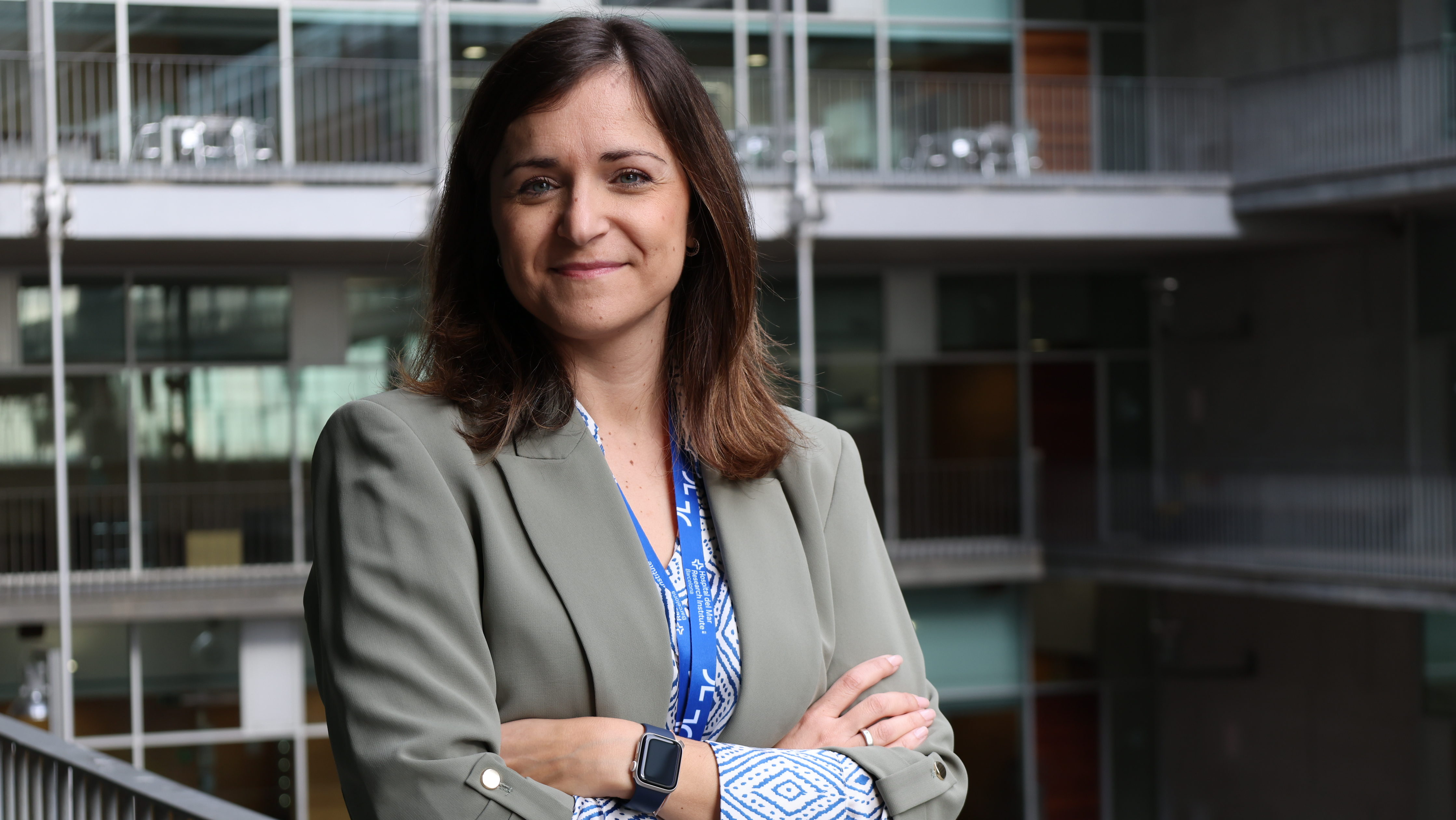
Since last February, Judit Cubedo has been the new manager of the Hospital del Mar Research Institute (HMRIB). With a background spanning research, innovation and strategic management, Cubedo champions a way of understanding management not only as a support structure, but as an active tool to make teams’ work easier and help the Institute grow.
You are taking on the management of the Hospital del Mar Research Institute at a key moment for the institution, with the new Mercat del Peix space on the horizon. How are you approaching this new stage, and what will your first priorities be?
I am arriving at a very important moment for the Institute, and one that is especially exciting, both because of the quality of the research being carried out here and the calibre of the teams involved, and because of its potential to have a real impact on society.
In this context, collaboration with the different actors in the ecosystem plays a key role as a catalyst for research and innovation. In this sense, the new Mercat del Peix space represents a very significant opportunity to strengthen these synergies, encourage interaction between institutions, and help generate new opportunities for scientific and translational development.
Your career combines research, innovation and strategic management. What do you think having worked across these different worlds brings to your role leading a biomedical research institute?
Having had the opportunity to work in research, innovation environments and strategic management has given me a cross-cutting view of the system.
On the one hand, I understand well the needs and dynamics of researchers, and on the other, I have worked in contexts where sustainability, decision-making and the ability to deliver are key factors. I think this combination gives me an integrated perspective and a particular sensitivity to the different parts of the system, and can help to better connect the scientific, clinical and management spheres.
Management is often described as a support structure, but less is said about its strategic role. What does it mean to you to have management that is truly at the service of research?
I think it is essential to strengthen understanding between the worlds of science and management, which often operate with different logics but are entirely complementary. Giving value to scientific activity is just as important as recognising the management work that makes it possible. Acknowledging the role of all parties — researchers, support teams and management teams — is essential to build trust and foster synergies.
In practical terms, this means working to ensure processes are clear and agile, making day-to-day work easier for teams, and ensuring that the institution supports researchers in areas such as operational management, fundraising, or the development of new initiatives.
Ultimately, it is about building a management model that not only responds to needs, but actively helps create the conditions for research to grow and have an impact.
Where do you think the main opportunities for growth for the Institute lie today?
On the one hand, in everything related to fundraising, both competitive funding and collaboration with other actors. Also in knowledge transfer and the translation of results to society, which is essential to move research towards impact.
In this context, I also think there is an important opportunity to continue advancing towards more efficient and modern management models. We now have more and more tools that can help streamline processes, and it is key to make the most of them so that management can support the Institute’s growth and help maximise its impact.
And finally, in the ability to create efficient and attractive working environments for talent, which is the Institute’s main asset.
What kind of working culture would you like to strengthen within HMRIB, both at team level and in relation to the research community?
I would like to help reinforce a culture based on trust, collaboration and shared responsibility.
I think it is especially important to promote good understanding between research teams and support areas, with fluid communication and mutual understanding of the needs and particularities of each sphere. This connection is key to generating more efficient working dynamics focused on shared goals.
Finally, beyond institutional objectives, what kind of mark would you like to leave during this stage at the head of management?
That is a difficult question at such an early stage. More than leaving a personal mark, I would like to help consolidate a way of working.
I would like this stage to be characterised by rigorous, approachable management, focused on making teams’ work easier, and by having contributed to strengthening the Institute from an organisational and sustainability perspective.
If, after some time, teams feel that management supports them better, that processes are clearer, and that the Institute is better prepared to face its challenges and generate impact, I think that will already be a meaningful contribution.