Every year, sustainability-focused initiatives become more common in our society, including within research institutes. Increasingly often we hear phrases like “We, as scientists, have a special responsibility in the face of the ecological crisis”. This is a positive tendency, as we should be conscious about one of the greatest challenges for our future. Yet at the same time, it is not becoming clearer: What should we do and how?
One unfortunate consequence of this confusion is the spread of greenwashing – the practice of using false sustainability statements by companies to increase their profit – and sciencewashing – the practice used by commercial companies, corporations, or governments to increase their profit or prestige by false or inconsistent scientific statements.
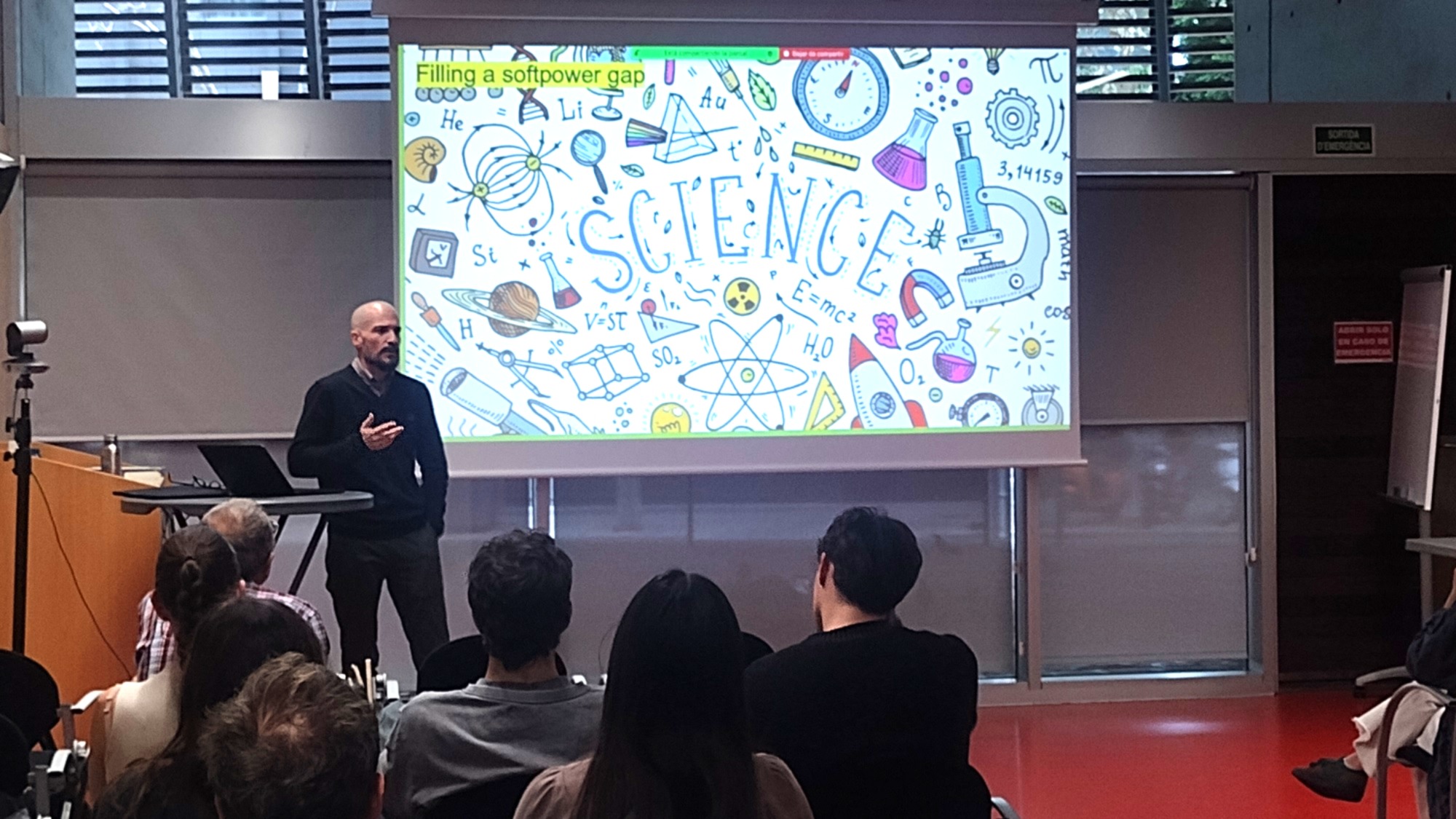
Javier del Campo, a group leader at the Institute for Evolutionary Biology (IBE: CSIC-UPF), talked about it on this month’s Sustainability Seminar “Science washes greener: The political and corporate use of scientific soft power”. We now have a reasonable understanding of greenwashing and know how to recognize it; for example, when a travel company offers “carbon offsetting” fees for their air flight tickets. But sciencewashing has recently taken a new turn and evolved from “this face cream will make you younger” to “this million-euros worth new technology will save an ecosystem”.
One well-known example often debated is the idea of human colonization of another planet if the Earth global ecosystem collapses and becomes hostile to life (a kind of plan B for escaping our planet). But the amount of money that should be invested in such a de novo project could potentially “fix” our planet with less effort and higher success probability.
Are we using science in the most efficient way to solve sustainability issues?
Less obvious examples are projects that promise to re-create damaged ecosystems, such as a coral replanting project involving the NFL (US National Football League) that gained a lot of popularity. However, such projects sometimes are planned for the sake of prestige and lack careful ecological and scientific planning. Protecting already existing coral colonies seems a more efficient strategy than planting new ones. Furthermore, there are very few follow-up studies that demonstrate whether such ecological restoration initiatives are actually effective. Sadly, science can go wrong – or at least fall short – and it is not always easy to tell the good from the bad in these cases.
So, what should we do and how?
One positive conclusion from such stories that Javier mentioned in his talk is that researchers do have power – the soft power of influencing the society. Greenwashing and sciencewashing exist because science is popular and researchers’ knowledge is respected. So, we should use it right to advance bottom-up approaches in the sustainability movement.
One of the simplest ways to do so is to facilitate dialogue between science and the public. Just find a way that works for you: from organizing activist groups or joining them, to volunteering at science communication events, to simply reading research reports on the topic and sharing the knowledge with your colleagues, friends, and family. Maybe we cannot fix everything at once and maybe we are too slow and will inevitably loose part of the Earth’s current biodiversity. But science has knowledge and skills on how to improve things and mitigate damage. And we, as scientists, still have our critical thinking – and our soft power.