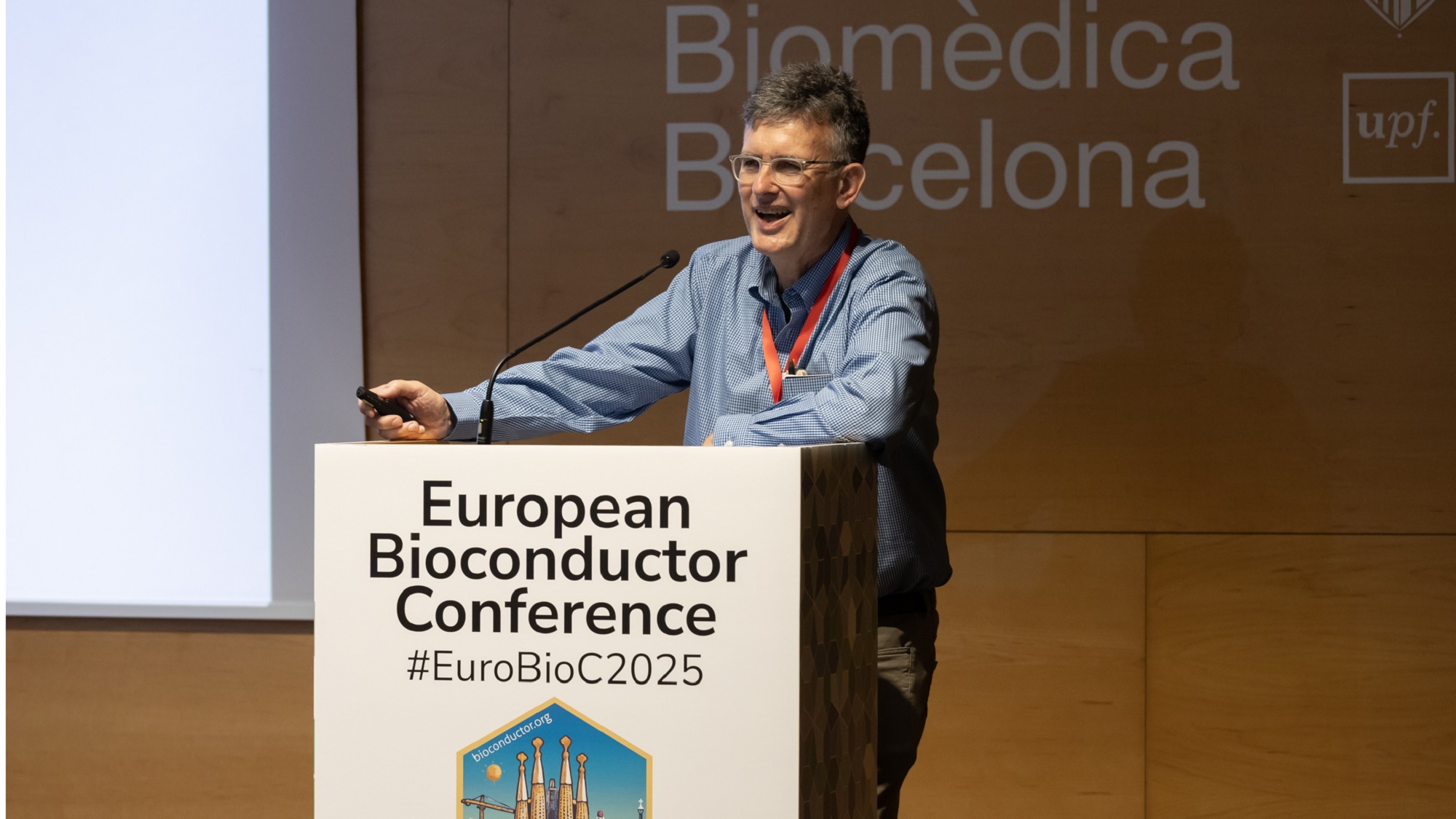
On 17, 18 and 19 September, the 19th edition of the European Bioconductor Conference (EuroBioC 2025) was held at the Barcelona Biomedical Research Park (PRBB). Bioconductor is an international collaborative project that aims to develop and disseminate free, open-source software that facilitates rigorous and reproducible analysis of data produced by current and emerging technologies in the field of biology.
“This mission is carried out thanks to a sustained effort to build a diverse, collaborative and welcoming community of users, developers and data scientists”, explains Robert Castelo, researcher in the Department of Medicine and Life Sciences, Pompeu Fabra University (MELIS-UPF), member of the Bioconductor community and co-organiser of this meeting at the PRBB.
Bioconductor holds three annual meetings, one in America, one in Asia and one in Europe. With some 170 registered participants from 24 different countries, this was the first time it was held in Spain.
“Hosting EuroBioC2025 in Barcelona has given the local bioinformatics community the opportunity to listen to and interact directly with a significant number of developers and members of the technical advisory board of Bioconductor, one of the most widely adopted open-source software projects in biological data science”
Robert Castelo, MELIS-UPF
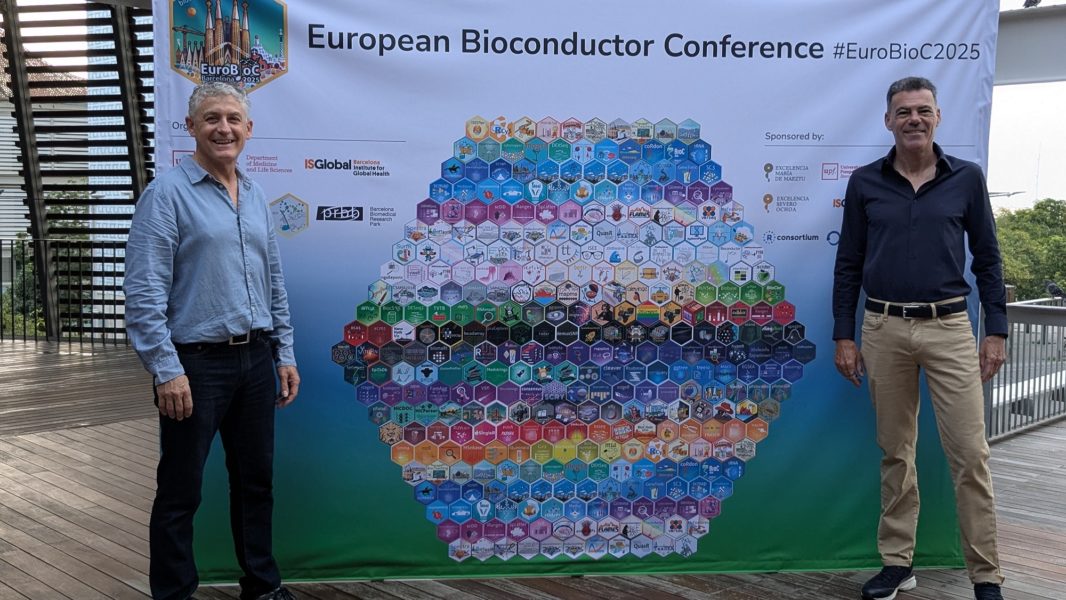
We spoke with Robert Castelo (MELIS-UPF) and Juan Ramón González (Barcelona Institute for Global Health (ISGlobal)), co-organisers of the conference, about the event and the Bioconductor initiative, which is celebrating its 25th anniversary this year.
How does Bioconductor work and what makes it special?
Bioconductor software runs on R, which is also open-source and free software for analysing and exploring data using statistical and computational methods. One of the main features of R is its ease of extending its functionality through so-called ‘R packages’, which anyone with minimal programming knowledge can contribute to and make available to all users through standardised repositories such as CRAN or GitHub. Bioconductor functions as another additional repository, making more than 2,000 community-contributed R packages available to users for analysing biological data.
In other words, anyone can upload a new ‘package’ or programme to Bioconductor…
Yes, this feature is crucial to understanding the widespread adoption of R and Bioconductor, as it allows users to transition to developers. Often, a researcher who is an expert in a particular field of knowledge will start out using Bioconductor software as a user, come up with an idea to improve the software or add functionality, and end up contributing a package and becoming a developer. In order to facilitate this transition, it is very important that the community is diverse and that everyone feels welcome to collaborate, which is why Bioconductor asks everyone who wants to participate to adhere to a code of conduct available in multiple languages.
“Often, an expert in a particular field of knowledge will start out using Bioconductor software as a user, come up with an idea to improve the software or add functionality, and end up contributing a package and becoming a developer”
What types of analyses can be performed with Bioconductor packages?
Examples of the types of biological data analyses commonly performed with Bioconductor packages include differential transcript expression analysis from massive RNA sequencing data, exploration and quality control of this massive RNA sequencing data in individual cells, the identification of expression domains in spatially resolved transcriptomic data, the analysis of differential peptide abundance from proteomic data produced by mass spectrometry, or the computational analysis of the biological function of genes and proteins – among many others!
It seems very useful and versatile; how many people use Bioconductor?
As Bioconductor software is available openly and free of charge without the need to register, it’s tricky to know how many people use it. Some indirect measures of its use include the number of downloads of Bioconductor packages, which exceeded 50 million in 2024; or the number of citations in scientific journal articles describing how the packages work. For example, some of the most widely used packages have tens of thousands of citations in Google Scholar.

What were the main topics discussed during the meeting at the PRBB?
As the possibilities offered by Bioconductor packages are vast, the conference covered a wide variety of topics. Some of the most relevant topics were how to analyse data in the field of spatial transcriptomics, or data from single-cell proteomics, as well as genomic technologies that quantify individual molecules (single-molecule genomics). Other topics included the integration of multi-omic data and interoperability between Bioconductor software and software developed in Python, another widely used programming language.
“Hosting the Bioconductor conference here has been a unique opportunity to connect the international community of data scientists and bioinformaticians with local researchers. At ISGlobal, we see this as a key step in strengthening open science, reproducibility and collaborative approaches in health research, values that are fundamental to our mission”
Juan Ramón González, ISGlobal
What would you highlight from this Bioconductor conference?
One of the highlights was the keynote speech that opened the conference by Vince Carey, professor at Harvard University and current head of the Bioconductor project, who reviewed Bioconductor’s 25-year history.
We would also like to highlight that, in addition to the guest lectures, short talks and posters typical of most conferences, we organised various interactive sessions:
- Five workshops in parallel sessions, lasting one hour and 45 minutes, where attendees had the opportunity to learn how to use a tool or perform a specific analysis, using their own device connected to a cloud platform that facilitates the execution of analyses without having to spend time configuring the device and installing software.
- Four simultaneous sessions, called ‘Birds-of-a-Feather’, where topics were discussed in a more open format. These types of sessions could be proposed by the participants themselves up until the day before the session.
Finally, how would you summarise the importance of projects such as Bioconductor?
Biology and biomedicine are now scientific disciplines in which the production and intensive use of large amounts of high-dimensional, multi-modal data have become essential for addressing research questions at the frontier of knowledge. Collaborative and open-source software projects such as Bioconductor are arguably the fastest and most rigorous way to provide tools for analysing these data and maximising scientific progress.