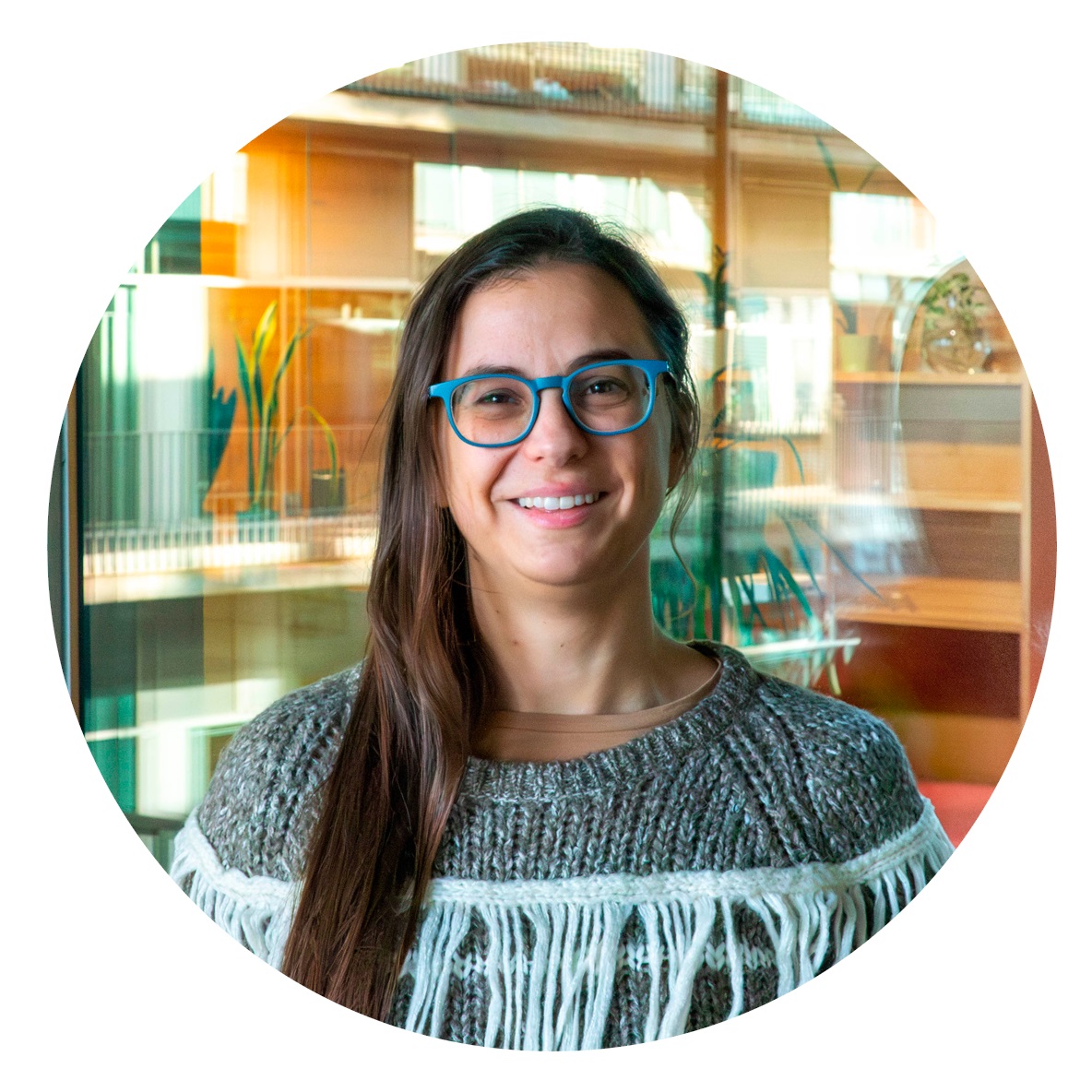
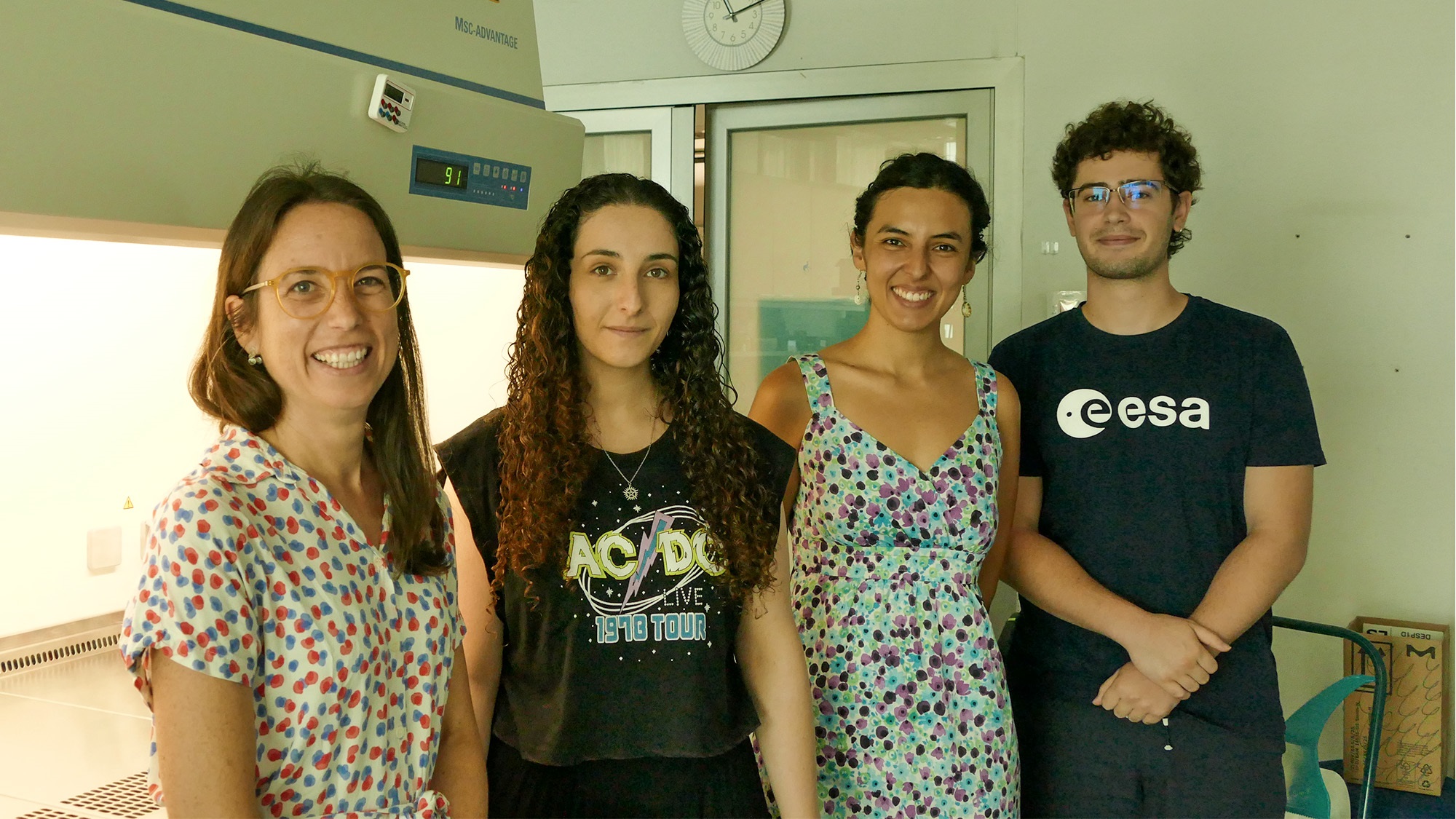
After 12 years in Zurich, Macarena Toll-Riera has returned to the Barcelona Biomedical Research Park (PRBB). Here, she did her PhD in Mar Albà‘s group (Hospital del Mar Research Institute). In September 2024, she came to the Institute of Evolutionary Biology (IBE: CSIC-UPF), another of the PRBB centers, as principal investigator of the evolutionary microbiology research group. Here she will continue the work she began at ETH Zurich, where she set up her group in 2019 with a PRIMA grant that promoted female researchers who showed great potential for obtaining a professorship.
How did you get into science?
I come from a family with a scientific tradition, so since I was little, I was interested in understanding why things happen.
And in the field of evolution?
When I started studying biology in high school, I discovered that I was fascinated by evolution. From the age of sixteen, I knew that this was what I liked. In fact, I did my secondary school research work on the evolution of primates.
Have you had any turning points in your research career?
During the penultimate year of my thesis, I went to a large conference on evolution. I attended a talk that introduced me to experimental evolution, in which we allow bacteria to evolve in the laboratory and study how they are adapting. All my research up to that point had been computational, but I remember sitting in the seminar and thinking, “I like this, I want to do a postdoc in this field.” I left feeling very excited. I don’t think I had ever been so excited about what I was hearing before. One of the groups working in this field was at Oxford, and when a position became available there, I didn’t think it twice. I applied and I got it.
After England, you went to Zurich. Why did you decide to come back to Barcelona?
For my family, to be closer to them. I had already been in Zurich for twelve years and in Oxford for a year. Besides, my daughters were getting older, and I wanted them to grow up with roots here.
And you came to the IBE.. .
I had the option of returning six years ago with a Ramón y Cajal grant, but at the same time I was awarded the PRIMA grant to start my group at ETH, so I decided to turn down the Ramón y Cajal grant and stay in Zurich for a few more years. I was really looking forward to doing the project I had written for the PRIMA grant, and we wanted to enjoy the Swiss mountains for a few more years. In 2023, I was awarded the Ramón y Cajal grant again, and this time the conditions were better, especially in terms of funding to carry out my projects. This time we decided to return. I have also been awarded a Research Consolidation grant, and with a postdoc we have been given a Juan de la Cierva grant.
Did your group come with you?
No. I already had plans to return to Barcelona when I was awarded the PRIMA grant, so I had already planned to find replacements for the different members so that everything would be settled when I left. The postdocs finished in August. One PhD student defended his thesis in September 2024, and there is only one other left in Zurich who knew from the beginning that I would be leaving. I had already laid the groundwork: we assigned him a co-supervisor at ETH Zurich, and we meet once a week. He will defend his thesis this fall.
Right now, my team consists of a lab manager (Alicia), a postdoc (Angélica), the PhD student at ETH Zurich (Gleb), and an undergraduate student (Artemi). Another postdoc (Javier) will join us in September.
What has been the most difficult thing about returning?
The bureaucracy. Here, everything requires a lot of paperwork, which wasn’t the case in Zurich. The hiring process is slower, as is the purchase of equipment… all of which has delayed my research.
On the subject of securing projects, what do you find most difficult about this process?
I really enjoy thinking up and writing new projects. But I find it hard to find the time to get started. Compared to Switzerland, applying for projects here is more complicated: you have to fill out more documents, you need more signatures, there are internal deadlines at the centers before the official deadlines for applications… It was simpler there.
Here you have also become involved in sustainability issues…
Yes, I am very interested in this area, and I have joined the Sustainability Committee of the IBE and also of the PRBB. At ETH Zurich, there were some initiatives that I think could be implemented here to make research more sustainable, such as always prioritizing train travel whenever possible.
Is there anything else you would like to say that I haven’t asked you about?
The importance of women in science. Many of us start out, but few of us reach the top. The PRBB is an exception; right now, the majority of group leaders are women. And then there is the issue of motherhood. The moment when we become principal investigators often coincides with when we become mothers. In my case, I found myself setting up a research group during the COVID pandemic, with a two-year-old daughter and a newborn baby. In fact, some of my fellow researchers from the PRIMA grant and I have written a book, recently published, about women in science in Switzerland, entitled “Women in Science: Experiences of Academics in Switzerland”. The chapter I wrote is called “Mums, Academia Needs You!”.