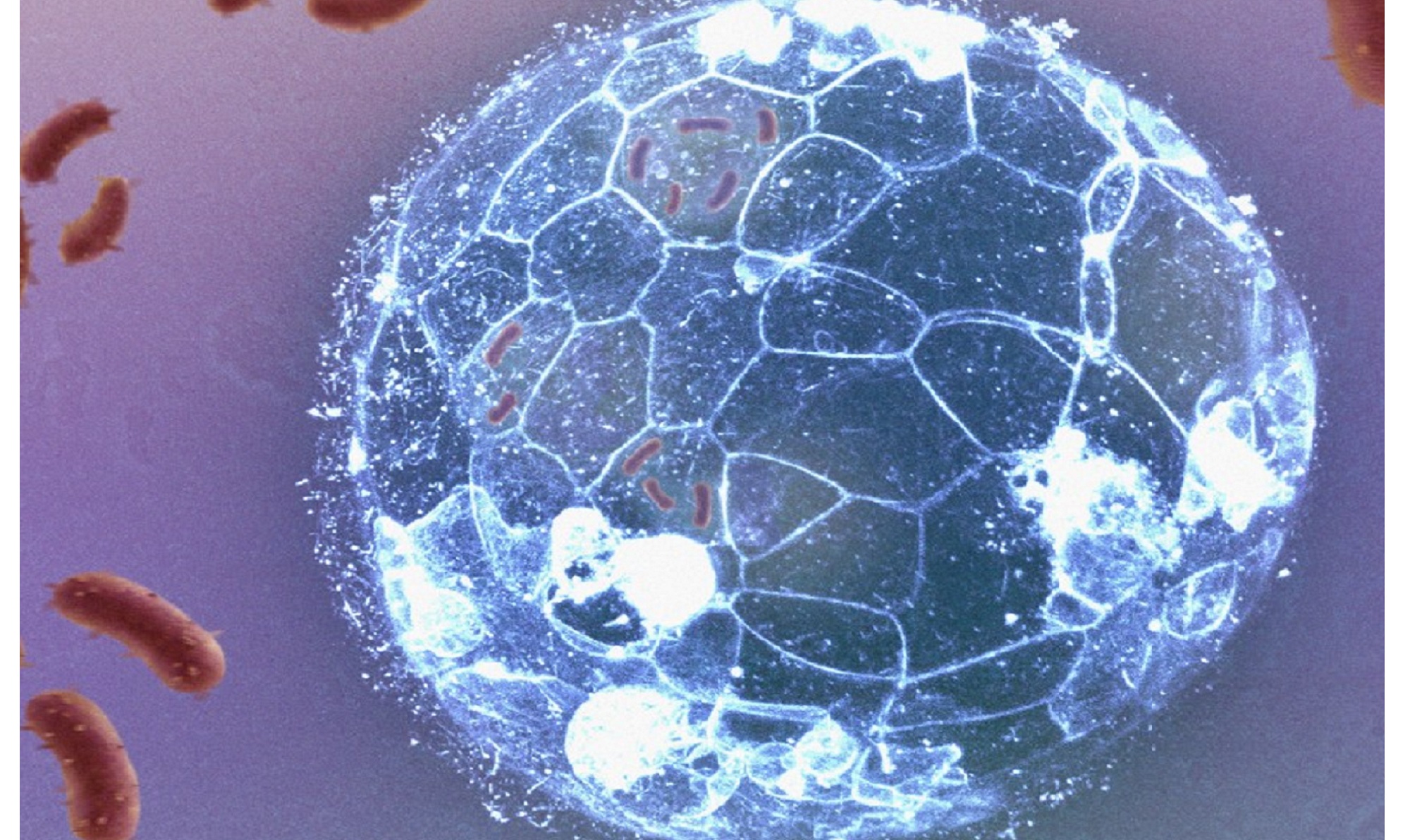
In this photo of the week, by PhD student Joan Roncero-Carol, we present a real image of a five- or six-day-old human embryo at the blastocyst stage. It is defending itself against bacteria, in this case added in red to the image, via phagocytosis. By this mechanism, the epithelial cells on the surface of the embryo engulf, ingest and destroy pathogens. Recent research has shown that this process occurs before the embryo is implanted in the uterus and long before the individual’s white blood cells are formed. In fact, the process could be the origin of immunity, according to Esteban Hoijman, lead researcher of the study.
These results were achieved using advanced microscopy techniques on zebrafish embryos, although the process also occurs in human embryos. In this case, they were fighting Escherichia coli and Staphylococcus aureus bacteria.
The research has been led by the Institute of Molecular Biology of Barcelona (IBMB) and the Bellvitge Biomedical Research Institute (IDIBELL). Researchers from the Department of Medicine and Life Sciences of the Pompeu Fabra University (MELIS-UPF), the Centre for Genomic Regulation (CRG), the Institute for Bioengineering of Catalonia (IBEC), the University of Barcelona (UB), the Dexeus University Hospital and the ICREA Foundation have collaborated.
Joan Roncero-Carol, June Olaizola-Muñoa, Begoña Arán, Loris Sebastiano Mularoni, Marta Miret Cuesta, Nuria Blanco-Cabra, Marc Casals, Mireia Rumbo, Miquel Sole Inarejos, Samuel Ojosnegros, Berta Alsina, Eduard Torrents, Anna Veiga, Manuel Irimia and Esteban Hoijman* Epithelial cells provide immunocompetence to the early embryo for bacterial clearance, Cell Host and Microbe. DOI: 10.1016/j.chom.2025.05.025.